


YABATECH Don Advocates Purpose-driven Administration, Effective Policy Decisions
…Sonibare urges administrators to strengthen institutional processes, embrace mentorship and prioritise long-term development
An outgoing Deputy Registrar of Yaba College of Technology (YABATECH), Dr. Julius Ayobami Sonibare, has called for a purpose-driven approach to institutional administration, effective decision-making, mentorship and strategic human-capacity development as essential requirements for sustainable growth in tertiary institutions.
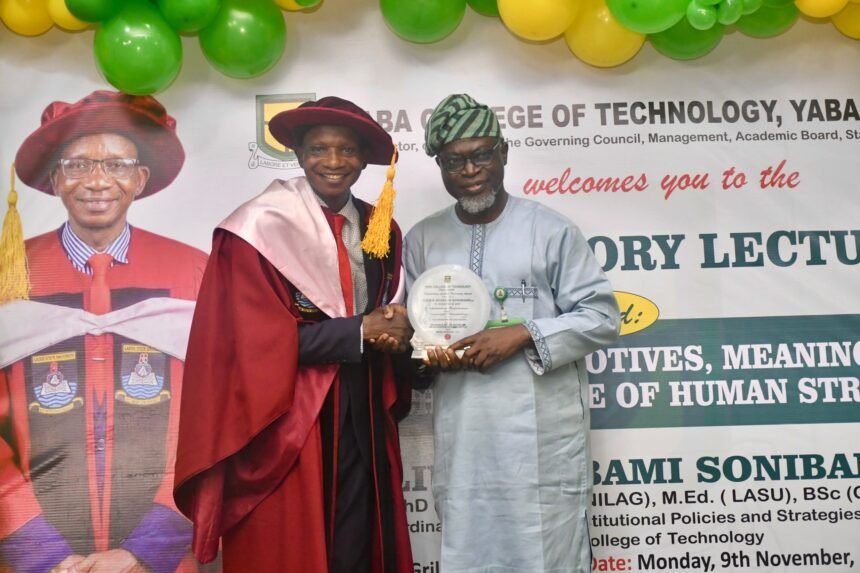
Sonibare made the recommendations while delivering the first Valedictory Lecture in the history of the College, where he challenged administrators, academics and other professionals to look beyond routine official responsibilities and understand the underlying purpose of their assignments.
In his lecture titled “The Motives, Meaning and Architecture of Human Struggles,” the mathematician and seasoned administrator emphasised that institutional success depends not merely on activities and structures but also on the motives, intentions, circumstances and choices that shape decisions and determine outcomes.
He urged workers to identify the purpose behind their responsibilities, stressing that every assignment, irrespective of its size or status, could provide an opportunity for learning, professional development and preparation for greater responsibilities.
He particularly advised administrators against undermining seemingly minor assignments, noting that experiences gathered through routine duties could become valuable assets in handling more complex administrative challenges.
Drawing from his professional journey, Sonibare recommended that organisations should encourage workplace learning, mentorship and the free exchange of knowledge across all levels of their workforce.
He observed that senior officers must remain receptive to learning from junior colleagues and subordinates, emphasising that professional knowledge is not the exclusive preserve of officers occupying higher positions.
On institutional governance, the former Deputy Registrar called for greater attention to the quality of administrative processes, particularly the preparation of memoranda, briefs, meeting agendas and decision extracts.
He explained that effective decision-making begins at the departmental and operational levels, where issues are identified and properly documented before being presented to management and governing authorities for consideration.
According to him, administrators have a critical responsibility to provide accurate information, sound professional advice and appropriate recommendations to decision-makers, warning that poorly prepared memoranda and inadequate guidance could lead to inappropriate institutional decisions.
He therefore urged registry professionals and other administrative officers to appreciate their strategic roles in institutional governance and ensure that every submission to management is properly researched, objective and directed towards achieving organisational objectives.
Sonibare also recommended that institutions should adopt a long-term perspective in policy formulation and decision-making, identifying time as a major variable in determining the success or failure of institutional interventions.
He cautioned against judging every decision solely by its immediate consequences, explaining that some decisions that might appear less attractive in the short term could provide opportunities for greater institutional benefits in the future.
Using his personal career experience, he advanced the principle that purpose should be greater than immediate financial profit.
He recalled choosing to remain at YABATECH despite having an alternative employment opportunity with considerably higher financial benefits, explaining that the professional exposure, experience and opportunities for growth offered by the College were more valuable to his long-term aspirations.
The lecturer consequently advised workers to consider the long-term implications of career decisions, rather than allowing immediate financial benefits to determine every professional choice.
He further advocated a collaborative approach to institutional administration, stressing that organisational objectives could only be achieved when every member of staff understood and effectively discharged their responsibilities.
Defining administration as the conversion of purpose into action, he maintained that lecturers, administrators, technologists and other categories of employees were all essential to translating institutional policies and objectives into practical achievements.
He urged tertiary institutions to strengthen the connection between policy formulation and implementation by ensuring that staff at all levels understood how their individual assignments contributed to the overall institutional mandate.
The Rector of YABATECH, Dr. Engr. Ibraheem Abdul, who welcomed guests and declared the lecture open, described the inaugural engagement as a deliberate effort to establish a culture of recognising excellence the teaching and non-teaching workforce.
He emphasised that institutional development was a collective responsibility and that the contributions of non-teaching staff should receive the same recognition as those of academic staff.
The Registrar, Mrs. Henrietta Adebola Badejo, read the citation of the valedictorian, while the Deputy Rector, Dr. Engr. Ismail Badmus, delivered the Rector’s address on his behalf.