



YABATECH Don Identifies Poor Leadership, Funding Delays, Strikes As Major Causes Of Project Failure
…Calls for strategic time management, effective planning to tackle project delays
A Chief Lecturer, in the School of Environmental Studies, Yaba College of Technology, Dr. Alaba Ezekiel Adetola, has identified poor project leadership, delays in the release of funds, industrial strikes and lockouts, ineffective communication and improper planning as some of the major factors responsible for delays and failures in construction projects in Nigeria.
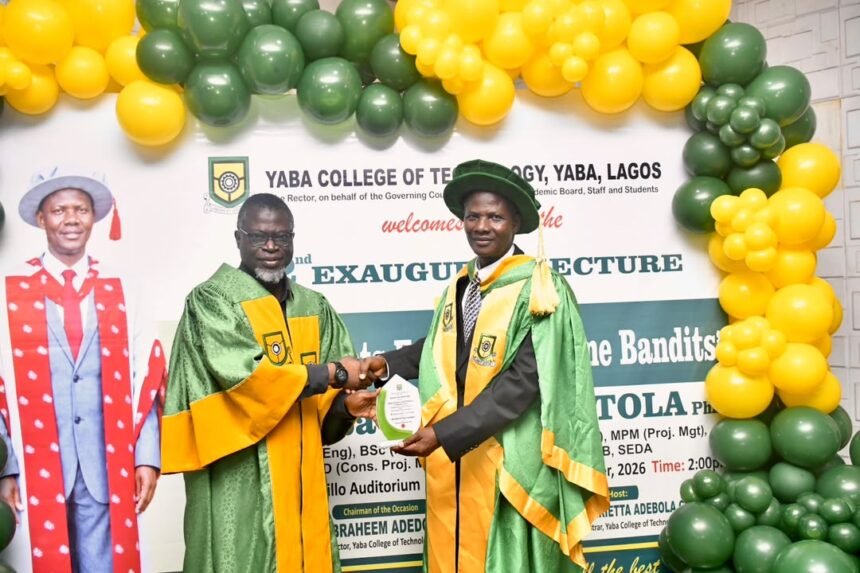
Adetola, who made this submission while delivering the College’s Second Exaugural Lecture at the Yusuf Grillo Auditorium, called for the adoption of effective project time-management strategies to eliminate activities that undermine project delivery, increase costs and compromise productivity.
The lecture, titled “Silver Bullets for Project Time Bandits,” examined the causes of time wastage in construction projects and proposed practical strategies for addressing the challenges, stressing that effective time management remains critical to the successful execution of projects in both public and private sectors.
Presenting findings from his research, Adetola disclosed that a survey involving 200 randomly selected construction project stakeholders across Nigeria’s geopolitical zones produced 140 completed questionnaires, representing a 70 per cent response rate.
The study, which employed statistical analysis to establish the relative importance of factors affecting project timelines, identified global pandemics as the highest-ranking time constraint, with a Relative Importance Index (RII) of 0.989. This was followed by industrial strikes and lockouts, delays in the release of project funds and poor project leadership, with an index of 0.982.
Other significant factors identified included improper project planning, ineffective communication among project stakeholders, inadequate technical expertise, adversarial relationships among stakeholders, shortage of construction materials, equipment breakdown, poor transportation systems, labour turnover and absenteeism.
He recalled the devastating impact of the COVID-19 pandemic in 2020, when construction activities across the world were suspended during the lockdown, explaining that the experience demonstrated how external disruptions could significantly affect project schedules and economic activities.
According to him, the research established that effective strategies exist for combating project time bandits, contrary to the assumption that project delays are inevitable.
Central to his recommendations was the application of the Urgent-Important Matrix, a time-management framework that classifies activities according to their urgency and importance.
He explained that activities requiring immediate attention should be distinguished from those that are important but not necessarily urgent, noting that excessive concentration on emergency-driven assignments often results in stress, exhaustion and poor productivity.
Adetola advocated that project managers and organisational leaders should devote greater attention to important but non-urgent activities, particularly planning, goal-setting, resource allocation, stakeholder engagement and preventive measures.
He explained that such an approach would provide managers with sufficient time to anticipate challenges, establish priorities and implement projects without being constantly overwhelmed by emergencies.
The lecturer also identified procrastination, habitual lateness, excessive social media engagement, unnecessary meetings, unplanned telephone conversations, visitors without appointments, trivial discussions, laziness and avoidable distractions as general time bandits that affect individual and organisational productivity.
He urged individuals and professionals to develop discipline in the use of time, stressing that time remains one of life’s most valuable resources and that its effective utilisation determines the level of achievement in personal and professional endeavours.
Defining a project as a temporary undertaking designed to produce a unique product, service or result, Adetola noted that every project has a definite beginning and end, measurable deliverables and specific timelines.
He explained that construction projects typically pass through inception, design, tendering, construction, commissioning and handover stages, adding that failure to effectively manage time at any of these stages could jeopardise the overall outcome.
He further described project management as the application of knowledge, skills, tools and techniques to coordinate and control project activities from inception to completion, within established requirements for quality, cost, safety and time.
According to him, the construction industry remains a critical driver of national economic development, as its activities encompass the planning, design, construction, maintenance and eventual demolition of infrastructure and facilities.
He therefore called for improved collaboration among project managers, clients, designers, contractors and public authorities, emphasising that effective communication and clearly defined responsibilities were essential to successful project execution.
The academic, who has spent three decades in the service of YABATECH, joined the institution in May 1996 as an Assistant Lecturer and rose through the ranks to become a Chief Lecturer in January 2019.
He has over four decades of professional experience in the built environment, construction project management, vocational and technical education, research, administration and human-capital development.
Adetola holds a PhD in Construction Project Management from the University of Lancashire, United Kingdom; a Master of Project Management from the University of Lagos; a Postgraduate Diploma in Technology Management from Obafemi Awolowo University; and a BSc in Vocational Industrial Technical Education from the University of Nigeria, Nsukka, among other academic and professional qualifications.
He is a Fellow of the Higher Education Academy, United Kingdom, and belongs to several professional bodies, including the Project Management Institute, United States; the American Society of Civil Engineers; and the Chartered Institute of Building, United Kingdom.
His research interests span construction project management, public-private collaboration, infrastructure asset management, procurement, leadership, climate change, vocational technical manpower development and sustainable development.
In his remarks, the Rector of Yaba College of Technology, Dr. Engr. Ibraheem Adedotun Abdul, who chaired the occasion, was represented by the Deputy Rector (Academics), Dr. Engr. Ismail Badmus.
The Rector commended the lecturer for the intellectual contribution and relevance of the subject to contemporary project management challenges, noting the importance of research, professional expertise and knowledge-sharing in advancing the College’s academic and institutional development.
He also underscored the importance of translating academic research into practical solutions that could address societal and national development challenges.
The Rector’s representative subsequently presented a commemorative plaque to Dr. Adetola in recognition of his successful delivery of the Second Exaugural Lecture.
The lecture was attended by principal officers of the College, members of the Management Team, academic leaders, directors, deans, deputy registrars, heads of departments, members of staff, students, professional colleagues, family members, friends and other invited guests.