


Lagos To Deploy 220 Trucks For Waste Evacuation- Hamzat
The Lagos State Deputy Governor, Obafemi Hamzat, said the state would increase its waste evacuation capacity with an additional 220 trucks.
This comes barely two months after Governor Babajide Sanwo-Olu announced that the state would soon take delivery of 150 compactor trucks to tackle waste evacuation.
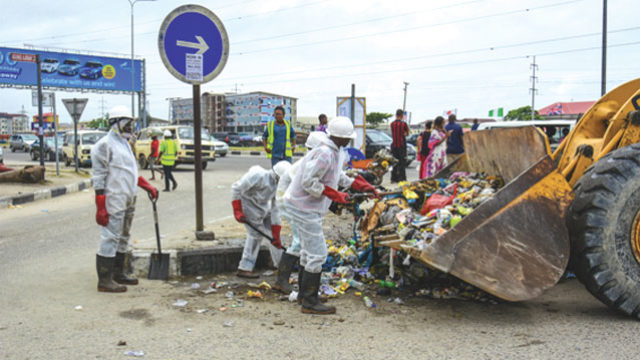
Hamzat said this while addressing journalists during the monthly environmental sanitation exercise held in Festac, Amuwo-Odofin Local Government Area of the state, on Saturday.
He noted that the new trucks would supplement the existing Private Sector Participation waste collection system.
He said the trucks would help the government respond to the growing volume of waste generated across the state as a result of population growth.
“The state government will be bringing in another 220 trucks to make sure that we supplement our PSP. What we need our people to also do is to make sure that they patronise their PSP, not the cart pushers, because they are not organised. You don’t know where the waste is ending up,” he said.
Reacting to a question on the waste situation in Lagos, Hamzat said the increasing number of people living and working in the state meant more waste was generated daily, making residents’ cooperation essential to effective waste management.
“A lot of people are coming to Lagos, and therefore they generate waste. So part of what you can see that we are doing is that we are getting many more trucks to actually go and evacuate,” he said.
He said residents had a responsibility to ensure that waste was properly disposed of, stressing that refuse dumped in canals could obstruct water flow and worsen flooding.
The deputy governor said the state government was encouraging communities across Lagos to organise regular environmental sanitation exercises, with the target of having residents clean their surroundings at least once a month.
“We cannot be a people without a healthy environment. It doesn’t matter what we do, a cleaner environment is what makes a city or a state sustainable,” he said.
Hamzat also urged residents to take personal responsibility for maintaining clean surroundings and use approved waste collection channels.
He said the government’s community engagement was aimed at encouraging residents to develop a culture of maintaining clean surroundings and creating a healthier environment for children and other residents.
Addressing environmental management in the Festac area, Hamzat noted that the Federal Housing Authority had responsibilities in the district but said residents and property managers were still required to comply with Lagos State environmental regulations.
He, however, stressed that the state government remained committed to ensuring that the environment was sustainable and conducive for residents.
Hamzat commended the local government chairman and residents for their participation in the sanitation exercise, saying community involvement was essential to sustaining environmental cleanliness across Lagos.
Also speaking, the Lagos State Commissioner for the Environment and Water Resources, Tokunbo Wahab, said waste management in the state was improving, attributing the progress to the deployment of 24-hour emergency response teams and measures to address challenges at landfills and dumpsites.
Wahab said the state government had also intensified engagement with PSP operators to improve waste collection across the state, noting that the government had intervened in areas where the Lagos State Waste Management Authority would ordinarily not operate.
He said the government had assured PSP operators of its support to enable them to improve waste collection, adding that residents were expected to pay for services rendered in line with the polluter-pays principle.
The commissioner said the arrangement would ensure that PSP operators were adequately supported while residents received the services for which they paid.
According to him, the government was also transitioning from the traditional linear waste management system, where waste is collected and dumped, to a circular system in which waste is recovered and converted into useful resources.
Wahab said the transition had led to the development of material recovery facilities in Badagry and Epe, as well as transfer stations at Soluyi and Olusosun.
On the activities of cart pushers, the commissioner said the government was engaging them but would not adopt measures that could create greater environmental and security challenges in the future.
He said investigations had shown that waste collected by some cart pushers was often dumped in drainage channels and road medians, contributing to environmental problems and flooding.
Wahab also expressed concern over reports linking some cart pushers to criminal activities, including the cutting and theft of metals, saying the government could not adopt a policy that would worsen security challenges in the state.