


Senate Committee Raises Concern Over Reduced TETFUND Allocation, Inspects Projects At YABATECH
The Senate Committee on Tertiary Institutions and Tertiary Education Trust Fund (TETFund) has raised concerns over a possible reduction in funding available to TETFund, warning that the development could further worsen the infrastructure challenges confronting universities, polytechnics and federal colleges of education across Nigeria.
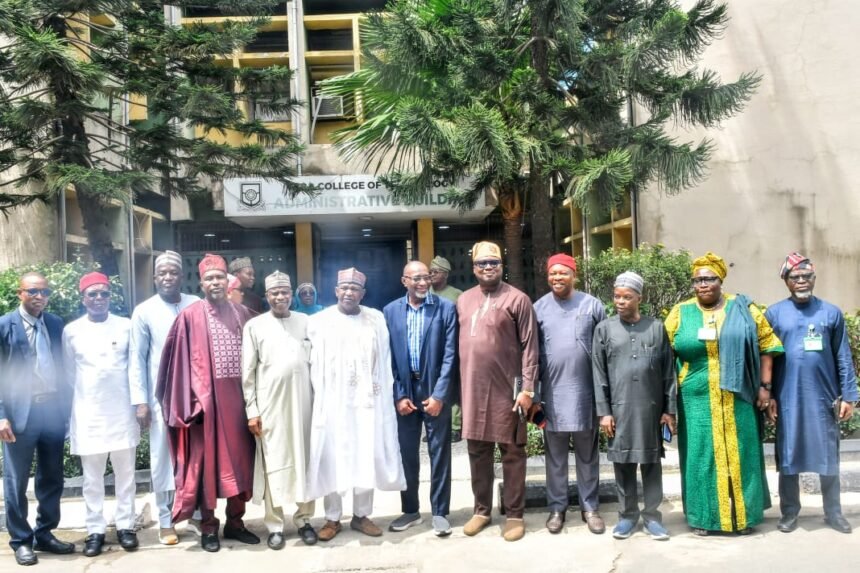
The Chairman of the Committee, Senator Mohammed Dandutse Muntari, representing Katsina South, disclosed this during the Committee’s official inspection of TETFund-funded projects at Yaba College of Technology (YABATECH).
Senator Muntari said the 10th Senate remained committed to ensuring that education was adequately funded and accessible, stressing that sustainable development could not be achieved without a strong educational system.
He expressed concern that changes associated with the country’s new tax regime and the sharing of development funds among government agencies could affect TETFund interventions.
According to him, discussions with the Executive Secretaries of NUC, NBTE, and NCC,E as well as the Executive Secretary of TETFund, indicated that the amount expected to be allocated to TETFund this year could be less than 50 per cent of what was allocated in the previous year.
He said such a reduction would have serious implications for infrastructure development, particularly with the emergence of new universities, polytechnics and federal colleges of education established under recent legislation.
“Education is key to success,” Senator Muntari said, noting that Nigeria needed to give greater priority to education if it must compete favourably with other countries.
He added that the Committee was at YABATECH to assess the impact of TETFund interventions and inspect projects executed between 2023 and 2025.
Welcoming the Committee, the Rector of YABATECH, Dr Engr Ibraheem Abdul, expressed appreciation to the Senate Committee and TETFund for their continued support to the institution.
Engr, Abdul said the interventions had contributed significantly to the College’s infrastructure development and improved the teaching and learning environment.
He described the inspection as an opportunity for the institution to demonstrate how it had utilised TETFund resources while reaffirming its commitment to accountability and the prudent management of public funds.
The Rector, however, highlighted the peculiar infrastructure challenges facing the institution, describing YABATECH as one of the most densely populated tertiary institutions in the country.
According to him, the College has about 35,000 students and more than 2,000 members of staff operating within a relatively small land area.
He explained that the limited space had forced the institution to adopt vertical development rather than the conventional horizontal expansion practised by many institutions.
“We cannot go horizontal; we have to go vertical because we have limited space. We have to build three, four and five floors in the college,” he said.
Engr. Abdul also explained that some old facilities, including structures built during the colonial era, were being removed to create room for modern multi-storey facilities.
He said the College had also adopted the practice of merging TETFund interventions from different years to execute projects that would have a more substantial impact.
According to him, the former Rector’s Lodge was among the facilities converted to create additional space for classrooms and other academic purposes.
The Rector said the approach had become necessary because TETFund interventions were generally designed around similar funding levels, regardless of the peculiarities and land constraints of individual institutions.
Engr. Abdul also drew attention to the huge demand for admission into the College, noting that YABATECH’s reputation continued to attract thousands of prospective students every year.
He recalled that hundreds of admission seekers protested outside the institution last year after they could not secure admission, despite their desire to study at the College.
The Rector explained that the institution could not admit all qualified applicants because it had to operate within the admission quota approved by the Joint Admissions and Matriculation Board (JAMB).
He, however, said the College was gradually developing its other campus to create additional space for academic activities and accommodate future expansion.
Beyond conventional academic programmes, the Rector said YABATECH had also intensified its skills development programmes to equip young people with practical skills relevant to the needs of the economy.
He noted that the College had leveraged TETFund interventions to support various skills development initiatives, including its Digital Technology Academy.
Also speaking, Senator Shuaib Afolabi Salisu, representing Ogun Central Senatorial District commended the management of YABATECH for effectively managing its large student population despite its limited land space.
He said the institution’s large student population was evidence of the strength and reputation of the YABATECH brand.
While commending the College’s decision to expand vertically, the senator urged the management to complement physical expansion with greater investment in digital education.
He advocated the use of technology to establish remote study centres and expand access to teaching and learning beyond the physical campus.
“Just as you are going up vertically, think of also going out digitally,” he said.
Senator Salisu said technology offered enormous opportunities for tertiary institutions to expand their reach and establish collaborations with leading institutions around the world.
He also urged YABATECH to explore interventions from other federal government agencies, including the Nigerian Communications Commission (NCC), National Information Technology Development Agency (NITDA) and the National Technology Incubation Centre.
He pledged his support to the institution and expressed optimism that he and other stakeholders would participate in YABATECH’s 80th anniversary celebration next year.
The inspection exercise provided an opportunity for members of the Senate Committee to assess completed TETFund projects at YABATECH, while the management presented the institution’s efforts to maximise the impact of the interventions despite its unique land and population challenges.