


Sub-nationals Must Drive Nigeria’s Investment, Tourism Growth – Shettima
The Vice President, Senator Kashim Shettima, has said Nigeria’s next phase of economic expansion will depend largely on the ability of states to properly document their assets, attract investment, grow tourism and convert local potential into jobs and shared prosperity.
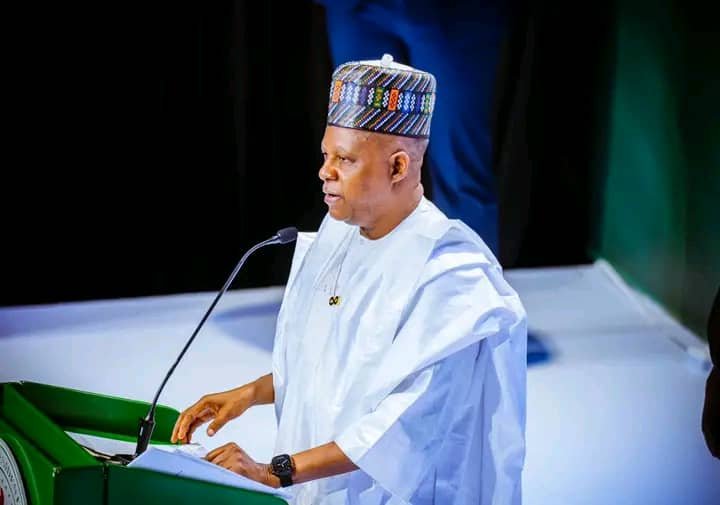
Senator Shettima spoke on Wednesday in Abuja during the Sub-National Government Economic and Tourism Information Roundtable and launch of the National Compendium on the Economic and Tourism Profiles of the 36 States and the Federal Capital Territory.
The Vice President who was represented at the event by the Special Adviser to the President on Economic Matters (Office of the Vice President), Dr Tope Fasua, said the document represents a major national tool for investment promotion, economic planning and tourism development.
He noted that the compendium aligns with the Renewed Hope Agenda by placing states at the centre of Nigeria’s growth strategy.
According to him, Nigeria is not poor in opportunities, but must do more to organise its assets, present them credibly and connect them to capital, markets, technology and investors.
“Nigeria is rich in assets, rich in talent, rich in culture, rich in enterprise and rich in natural endowments. What we must do is organise these assets, document them properly, present them credibly, and connect them to capital, markets, technology and investors,” VP Shettima said.
He described the compendium as a national investment document, a tourism guide, an economic intelligence tool and a branding instrument for telling Nigeria’s story in a more structured and compelling way.
“For too long, our story has been told from the narrow lens of challenges. Today we tell a broader story of opportunity, resilience, creativity and partnership,” he added.
Senator Shettima averred each state has a distinct economic advantage that can be developed into bankable projects, noting that some states are strong in agriculture, solid minerals, gas, logistics, manufacturing, ICT and tourism, while others possess major cultural and natural attractions.
He said the real policy challenge before government is to move beyond identifying potential to building practical investment pipelines that can create jobs.
“The challenge is how to convert potential into projects, projects into investments, investments into jobs, and jobs into shared prosperity,” he said.
The Vice President stressed that while the Federal Government will continue to provide policy direction, infrastructure support and diplomatic engagement, states remain the real engines of inclusive growth because they control the spaces where investments are located and where citizens directly experience development.
“The Federal Government provides direction, policy, infrastructure and diplomatic engagement, but the real engines of inclusive growth are the states. The states are where land sits, where agricultural clusters form, where tourism assets are situated, where young people seek jobs, and where investors must establish factories, farms, hotels and service businesses,” he said.
VP Shettima urged state governments to improve ease of doing business, secure communities, provide reliable data, identify their comparative advantages and build responsive institutions that can support enterprise.
He said Nigeria’s festivals, music, historic cities, natural attractions, ancient kingdoms, beaches, waterfalls, mountains, warm springs and wildlife can attract global interest if properly mapped, protected, developed and marketed.
“Tourism assets do not market themselves. They must be mapped, protected, developed, secured and linked to private investment,” he said.
The VP explained the initiative is also linked to the Sustainable Development Goals, especially in the areas of poverty reduction, decent work, industrial growth, innovation, reduced inequality, sustainable cities, responsible production and partnerships.
He said these goals cannot be achieved through declarations alone, but through practical investment, credible data and public-private partnerships.
The Vice President commended the Nigeria Press Council, the Nigeria Governors’ Forum, the Federal Ministry of Information and National Orientation, the Federal Ministry of Art, Culture, Tourism and the Creative Economy, the Nigerian Tourism Development Authority and other partners involved in producing the compendium.
“To bring all 36 states and the FCT into one document is a statement of unity. Our diversity is our greatest economic and cultural asset,” he said.
Earlier, the Minister of Information and National Orientation, Mohammed Idris, said the national compendium is one of the laudable initiatives coming at a time when the Federal Government is implementing bold reforms across the country.
He urged state governments to engage with the relevant information contained in the compendium and view the economic and tourism profiles outlined in the document as a “call to action” for development.
For her part, the Minister of Art, Culture, Tourism and the Creative Economy, Hannatu Musa Musawa, represented by the ministry’s Permanent Secretary, Abdulkarim Ozi Ibrahim, said the roundtable provides an opportunity for states to identify their investment opportunities in hospitality, the economy, tourism and digital innovation, while showcasing them to the world.
Also speaking, the Executive Secretary and Chief Executive Officer of the Nigerian Press Council (NPC), Dr. Dili Ezughah, pledged the council’s support for research and documentation.
He noted that the council would continue to sustain partnerships with relevant agencies and the private sector, aimed at driving the economic transformation of the federation.