


Sanwo-Olu Wins Governor Of The Year Award ‘At National Civil Society Organisations Summit
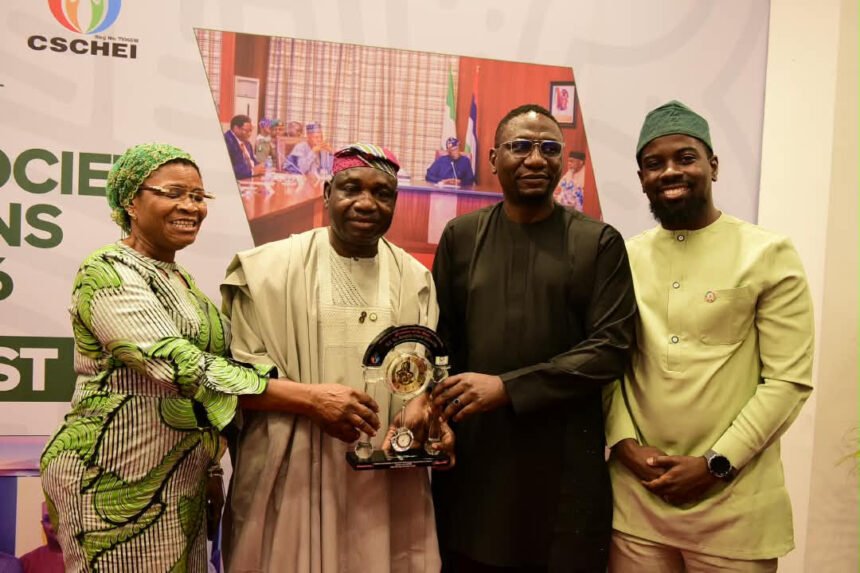
Governor Babajide Sanwo-Olu has been honoured with ‘The Governor of The Year Award’ by the National Leadership of Accredited Civil Society Organizations and Civil Society Organization on Community Advancement and Humanitarian Empowerment Initiative (CSCHEI).
The honour was bestowed on the governor at the National Civil Society Summit held on October 2nd, 2026, at the Bola Ahmed Tinubu International Conference Centre in Abuja, to discuss governance, socio-economic growth, citizens welfare, rule of law, and national unity. Specifically, the discussion centered on improving Nigeria’s nationhood, through responsible governance and a functional democracy.
Themed: NIGERIA FIRST, the summit, declared opened by the President of the Federal Republic of Nigeria, Bola Ahmed Tinubu, GCFR, represented by the Secretary to the Government of the Federation, Senator George Akume, was a convergence of representatives of Civil Society Organisations and other stakeholder groups from across the country.
Aside from the main event, there were subject-based technical sessions by experts from various fields of human endeavours, including the diplomatic community, academia, social development, government and CSOs, before an award ceremony, which acknowledged outstanding performance in public service and commitment to social development.
“This Governor of The Year Award to Governor Babajide Sanwo-Olu recognises his excellent leadership in public service, commitment to Sustainable Development Goals (SDGs) and adherence to the tenets of democracy. From our audits of the thirty-six states of the federation, with scope covering infrastructural development, SDGs alignment, rule of law, youths empowerment and enterprise promotion, Lagos State is a clear leader”, announced the Award Committee.
“We found incontrovertible evidence of intentionality in policies and programmes that elevate the elements in this scope and undoubtedly benefit humanity, and the society at large. Lagos State residents and the state itself are the direct beneficiaries of the visionary leadership of their governor, but we are happy to point him out as a glittering example of exceptional leadership in our democracy”, it asserted.
“Without any doubt, the visible alignment with SDGs 4, 8, 9,11,13,and several others are conspicuous in the state’s programmes and projects. For instance, the Blue Line, which is the first sub-national electric-powered rail system in Africa has significant positive impact on the climate, with a projected reduction of 1.5million tonnes of CO2 emission through a modal shift from internal combustion vehicles to low-carbon mass transit.
Likewise, the construction of the largest integrated primary and secondary school cluster in the West African subregion to expand access to inclusive and equitable quality education, and the largest Children’s Hospital in West Africa are laudable projects that align firmly with the SDGs” concluded the Committee.
Governor Babajide Sanwo-Olu, who was represented at the summit by a delegation comprising Olusegun Fafore, Special Adviser, Public Relations, Documentation and Repository, Titi Oshodi, Special Adviser, Climate Change and Circular Economy, Bukola Omope Adeddeji, Chairman, Bariga LCDA and Engr. Olusegun Michael Folorunso, Senior Special Assistant on SDGs to the Governor, led by Mr, Gbenga Omotoso, Commissioner for Information and Strategy, spoke through Olusegun Fafore, who dedicated the award to God Almighty for the opportunity to serve humanity and the people of Lagos State, especially.
“I would like to thank the CSOs across Nigeria, our accountability partners for their contributions to national development and our society at large. This award is for the good people of Lagos State. It is a recognition of our government’s legacy of excellence in public service”, Fafore said.
Earlier in his welcome address, Amb. Kunie Yusuff, Fincsd, MON, Director-General, CSCHEI and National Convener of the Summit had described the gathering as “significant and historical because a convergence of civil society organisations of this magnitude had only happened shortly after the Nigerian civil war”.
“Here we are now, a day just after Nigeria’s 66th independence celebration, deliberating on the pathway to a greater and better Nigeria” stressing that “the Nigeria First is not a slogan, but a call to action and an expected way of collective thinking and acting, to safeguard the interest of our beloved country, Nigeria”.