


NURTW, RTEAN Sign Historic Agreement To Drive Lagos Bus Industry Transition Programme
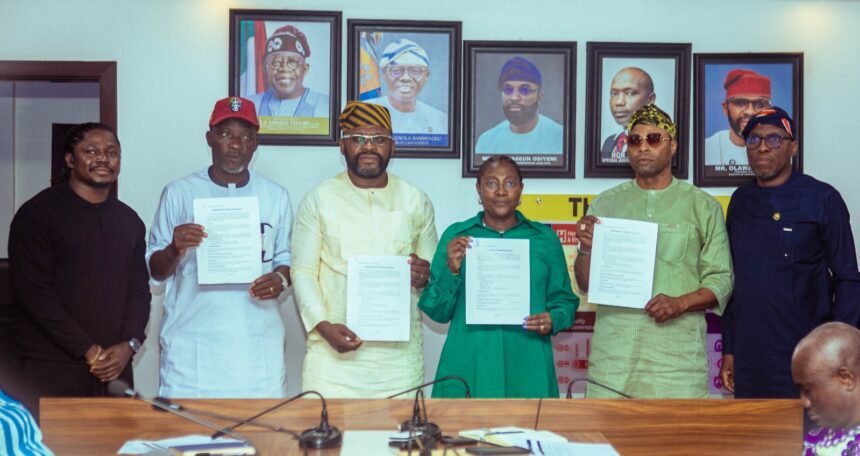
The two major transport unions in Lagos State—the Nigeria Union of Road Transport Workers (NURTW) and the Road Transport Employers Association of Nigeria (RTEAN)—have signed a landmark Memorandum of Understanding (MoU) to participate in the Lagos State Bus Industry Transition Programme (BITP), marking a significant milestone in the transformation of public transportation in the state.
Describing the agreement as “a new beginning for public transport in this state,” the Permanent Secretary, Lagos State Ministry of Transportation, Mr. Olawale Musa, said the MoU demonstrates the commitment of the Lagos State Government and transport stakeholders to building a safer, more efficient, and sustainable public transport system.
The BITP is a Lagos State Government initiative being implemented by the Lagos Metropolitan Area Transport Authority (LAMATA) to integrate informal commercial transport operators, including the iconic yellow danfo buses, into a regulated, structured, and modern public transport network.
The historic agreement was signed by Lagos State Chairman of RTEAN Mr. Samson Ajala Adepeju and Secretary, Bolaji Kawojue, alongside Alhaji Mustapha Adekunle Sego and Secretary, Comrade Usman O. Teslim for (NURTW), while the Permanent Secretary, Lagos State Ministry of Transportation, Mr. Olawale Musa and the Managing Director of LAMATA, Engr. Mrs. Abimbola Akinajo signed on behalf of the Lagos State Government.
The MoU establishes the guiding principles and expected outcomes for the implementation of the BITP. It provides a common framework for the transition of bus operations across the state’s eight Quality Bus Corridors (QBCs) and forms the basis for the granting of bus operating franchises under the new system.
Under this new operational model, transport unions will be structured using a cooperative societal governance model to manage union members’ transition into franchise operators. Fare collections will adopt a fully digital payment system to streamline revenues, while LAMATA will maintain strict regulatory oversight across all routes.
Four key Quality Bus Corridors (QBCs) currently under construction to launch this integrated system include: Iju Ishaga – Abule Egba, Ketu – Alapere – Akanimodo, Iyana-Iba – Igando – Iyana-Ipaja, Ojuelegba – Lawanson – Cele.
Speaking at the signing ceremony, the Managing Director of LAMATA, Engr. Mrs. Abimbola Akinajo, highlighted the significance of the agreement, noting that the journey to its realization began more than 30 months ago through sustained engagement and collaboration with the transport unions.
According to her, the successful integration of the formal and informal transport sectors in Lagos has the potential to become a global reference point for cities seeking to modernize their public transport systems while ensuring the inclusion of existing operators.
“This will become a baseline for other cities because it will be a verifiable example of a handshake between government and the unions,” she said.
Engr. Akinajo stressed that the formalization of public transport should not be viewed as an attempt to suppress or marginalize transport operators.
“Formalization should not be construed as strangulation. When we collaborate, the result will be formidable and capable of being replicated across other parts of Nigeria and in cities around the world that are seeking to formalize their public transport operations,” she added.
The signing of the MoU represents a major step in Lagos State’s ongoing efforts to reform the public transport sector by improving service quality, enhancing commuter safety, promoting operational efficiency, and creating a sustainable and investor-friendly bus transport industry.