



Can Tinubu’s 2027 Manifesto Win Over Struggling Nigerians?, By Kazeem Akintunde
Ahead of the January 16, 2027 presidential election, President Bola Tinubu is facing mounting challenges driven largely by economic hardship, persistent insecurity, regional dissatisfaction in Northern and Eastern Nigeria, and internal divisions within the ruling All Progressives Congress (APC). Despite the challenges, the Jagaban of Borgu seems unfazed, as he marches on in his bid to secure a second term. Since August 19th, when the Independent National Electoral Commission (INEC) formally lifted the ban on political campaigns, Tinubu has been to seven states to sell his candidacy to the electorate, telling Nigerians what he intends to do, if given another four years as President. Although he admitted that he may not be able to attend all campaign rallies across the country, Tinubu has, so far, been to Akwa Ibom, Rivers, Jigawa, Kebbi, Oyo, Borno, Lagos and Enugu states.
On his recent campaign visit to Lagos, he met with Ndigbo members of his party. But the big question remains: Is his message resonating with the masses? Most Nigerians want to know whether he has been able to fulfil the campaign promises he made to them in 2023 and if their life has significantly improved since then to warrant his re-election. Many Nigerians are still dazed by his inaugural address, which effectively removed fuel subsidy and the impact of which is still being felt by Nigerians till date. As at the time of his inauguration, petrol was sold in the country at N185 per litre, but by the end of that same day, many filling stations had adjusted their pump prices to between N488 and N550. That is the power of deregulation and an open market economy. With the fuel subsidy removal, the World Bank projected that between seven to 10 million Nigerians were dragged into poverty due to the sharp increase in the cost of living and inflation.
A few days later, the dual exchange rate for the dollar was harmonised, triggering severe spikes in living costs. Transportation cost went haywire. In 2022, 133 million Nigerians were said to be multi-dimensionally poor, according to the National Bureau of Statistics (NBS) in its Multidimensional Poverty Index (MPI) Reports. A year later, that figure rose to 140 million Nigerians. Out of the number, 65 per cent of those said to be multidimensionally poor live in the North and 35 per cent in the South. State incidence ranged from 27 per cent in Ondo state to 91 per cent in Sokoto state. In spite of the fact that their kinsman, the now late President Muhammadu Buhari, was in power for eight years without any clue on how to rescue the region from poverty and want, anger and resentment built up against his successor, President Bola Tinubu.
Most parts of the North also face persistent attacks from bandits and kidnappers, a by-product of the scant regard given to education by past administrations in the region. A region with over 10 million out-of-school children left to roam about the streets 15-20 years ago, soon saw before their very eyes, the same children they abandoned become foot soldiers for bandits and kidnappers, turning the region into a hotbed of insecurity. Criminal elements in the North now impose levies on communities before they are allowed to farm. In some other areas, they have established a sharing formula applied to the proceeds from farmers during harvest for ‘peace’ to reign.
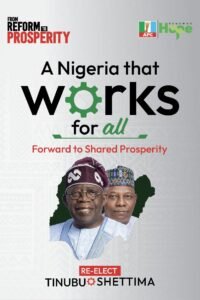
With less than two months to the Presidential election, President Tinubu has unveiled his manifesto for the 2027 presidential election, titled From Reforms to Prosperity: Agenda 2027–2031, and has vowed to make life better for the masses.
Published in October, 2026, the document is more than a presentation of campaign promises. It is an attempt by the ruling party to explain the direction of its economic and governance policies, defend the reforms undertaken since President Tinubu assumed office in May 2023, and persuade Nigerians that the most difficult phase of the journey is behind them.
At the heart of the document is the Renewed Hope Agenda 2.0, the proposed second phase of the administration’s reform programme. Its central argument is straightforward: the first term has been devoted largely to confronting structural weaknesses in the economy and rebuilding the foundations of national development. If the APC receives another mandate, it will concentrate on converting those reforms into tangible prosperity for Nigerians.
The distinction is important. Nigerians have experienced the consequences of the first phase, particularly the removal of the petrol subsidy, the unification of the foreign exchange market, and changes to the country’s tax and fiscal arrangements. These decisions generated intense public debate and imposed considerable pressure on households and businesses. The government maintains that they were necessary to correct longstanding distortions and place the economy on a more sustainable footing.
The question now is whether the anticipated benefits will reach the people in a manner they can see, feel and measure. That is the political and economic challenge Renewed Hope Agenda 2.0 seeks to address. The document argues that the reforms have strengthened public finances, improved the foreign exchange system, and created greater capacity for investment in development. It presents the next phase as an opportunity to move beyond stabilisation and deliver improvements in household purchasing power, employment, business competitiveness, and public services.
The manifesto cites several indicators to support its argument. According to the figures presented, foreign reserves rose to $55.3 billion in September, 2026, compared with $33 billion in May, 2023. Net reserves, it says, increased from approximately $4 billion to $32 billion. It also reports that monthly Federation Account Allocation Committee (FAAC) distributions reached an average of ₦3 trillion in 2026, compared with an average of ₦900 billion between 2019 and 2023. The document puts Nigeria’s second-quarter 2026 GDP growth at 4.43 per cent, and September 2026 inflation rate at 14.63 per cent, down from a peak of 34.8 per cent in December, 2024.
Other figures include $23.2 billion in capital inflows in 2025, a ₦12.6 trillion trade surplus in the second quarter of 2026, and a 374 per cent increase in the Nigerian Exchange Group index since May, 2023. These are figures presented by the APC manifesto as evidence of economic progress rather than independent confirmation that the benefits have been evenly distributed across the population.
The distinction between macroeconomic improvement and household welfare is particularly important. This is where Renewed Hope Agenda 2.0 is making its strongest case. The APC is effectively asking Nigerians to give the administration another opportunity to demonstrate that the sacrifices associated with its first-term reforms can produce a more prosperous society. It is a proposition that will require more than economic statistics. It will require results that are visible in homes, markets, farms, factories, schools, and communities.
One of the significant features of the October 2026 manifesto is the consolidation of the original Eight-Point Renewed Hope Agenda into four strategic pillars. The eight priorities announced in 2023 covered economic reform, national security, agriculture, energy, infrastructure, education and healthcare, economic diversification and governance.
For the 2027–2031 period, the APC has reorganised these priorities into four broad areas:
- Secure and Resilient Nation.
- Better Quality and More Affordable Life for Every Nigerian.
- Energy, Infrastructure and Economic Growth.
- Effective and Accountable Governance.
This arrangement gives the new manifesto a more integrated character. Security, for instance, is no longer treated simply as a military responsibility. It is connected to employment, agricultural production, economic opportunities, and community development.
Similarly, infrastructure is presented not merely as a collection of roads, bridges, and railway projects, but as an essential foundation for industrialisation, trade, agriculture, and employment.
The underlying philosophy is that national prosperity cannot be achieved through isolated interventions. Security must support production; infrastructure must connect markets; education must produce employable graduates; healthcare must protect the productivity of the population; and governance must ensure that public resources translate into services.
The manifesto also identifies four foundations of national development: macroeconomic stability, the rule of law, institutional capability, and national cohesion. These are expected to support the implementation of the four pillars across the federation.
The ultimate ambition is that by 2031, Nigerians should experience a country in which security is improved, inflation is substantially lower, electricity is more reliable, businesses are expanding, jobs are available, and public institutions are more responsive.
It is an ambitious vision. Its success will depend on the government’s ability to translate policy intentions into properly funded programmes and measurable outcomes. Security is arguably one of the most pressing challenges confronting Nigeria. Terrorism, banditry, kidnapping, communal violence, attacks on farmers, and criminal activities along highways have affected communities across different parts of the country.
The consequences extend beyond the loss of lives and property. Insecurity discourages farming, disrupts education, weakens commercial activities, and drives families away from their homes. For a farmer in parts of Zamfara, Katsina, Kaduna, Niger or Benue, the fear of being attacked can be as damaging as the inability to obtain fertiliser or agricultural credit.
For parents in communities affected by school kidnappings, the decision to send their children to school becomes a matter of personal risk. The APC manifesto recognises this wider dimension of insecurity. Its first pillar promises to guarantee the right of Nigerians to live, work, travel, learn, worship, and raise families in greater safety.
The proposed strategy combines military operations, intelligence gathering, improved policing, border protection, community-level security and stronger emergency response systems. One of the major commitments is the completion and equipping of four additional Army divisions in Makurdi, Ilorin, Jalingo, and Benin City. The government also promises to recruit, train, and deploy 28,000 additional military personnel already approved for the expansion.
The manifesto further promises specialised zonal counter-terrorism capabilities and sustained intelligence-led operations against insurgent and kidnapping networks. However, military expansion alone will not solve Nigeria’s security problems. The APC recognises this by proposing stronger community policing and a more visible police presence.
It promises to train and deploy 50,000 newly recruited police officers, with the broader objective of moving towards a police-to-citizen ratio of one officer to 400 people. The proposed police reforms include digital record systems, geographic mapping, body cameras, emergency dispatch channels, and improved forensic infrastructure.
Electricity remains one of the biggest obstacles to Nigeria’s industrial development. Manufacturers spend substantial resources providing alternative power, while small businesses often struggle to remain competitive because of the cost of running generators. For households, unreliable electricity affects education, healthcare, food preservation, and general quality of life. The Tinubu administration has introduced reforms through the Electricity Act 2023, which provides a framework for states to establish and regulate their own electricity markets.
The APC manifesto proposes building on this reform by strengthening federal and state cooperation, encouraging embedded and captive power generation, improving transmission and distribution networks, and expanding metering. It also promises to address the commercial problems of the electricity industry, including technical and commercial losses, payment arrangements and legacy liabilities. The target is to raise sustained average electricity generation to at least 7,500 megawatts and achieve peak generation of 10,000 megawatts by 2031.
President Tinubu and his APC went on and on in the manifestos of what and what he intends to do to make life more meaningful to the masses but the real question is whether Nigerians trust this administration to deliver on its promises if given a second chance. That ultimate question would be answered on January 16 next year, when Nigerians head to the poll to either give Tinubu a second term ticket or vote in a replacement.
See you next week.