


INEC Challenges Parties To Move From Lip Service To Action On Women’s Political Participation
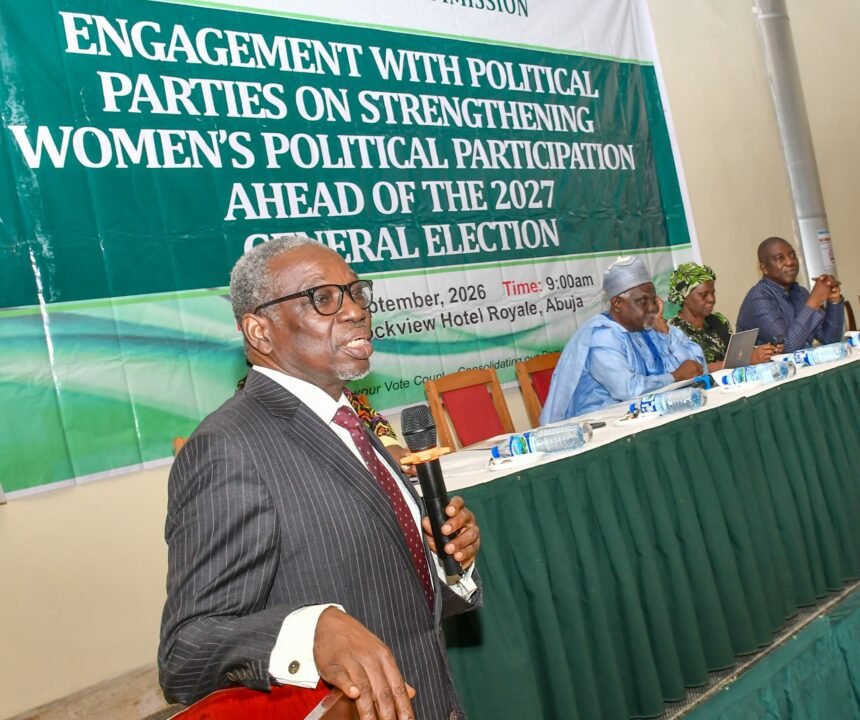
“A democracy that mobilises women as voters but provides limited pathways for them to become political leaders is yet to fully realise its representative potential.” With these words, the Independent National Electoral Commission (INEC) on Tuesday challenged political parties to move from lip service to concrete action on women’s political participation, as it convened a strategic engagement with party leaders, female candidates, civil society organisations, development partners and the media in Abuja, ahead of the 2027 General Elections.
The remarks, contained in opening remarks by the Chairman of the Commission, Prof. Joash Amupitan, Represented by National Commissioner, Prof. Rhoda Gumus, at the engagement held on Wednesday 9th September, 2026, at the Rockview Hotel Royale, Abuja.
Prof. Gumus told participants that the question before the Commission was “not simply about the participation of women in one electoral cycle,” but one that goes to “the character, inclusiveness and long-term sustainability of Nigeria’s democracy.” She noted that women remained a formidable presence in Nigeria’s electorate, pointing out that 44,414,846 of the 93,469,008 registered voters in the 2023 General Election, or 47.52 percent, were women, “almost one in every two registered voters in the last General Election.”
She said this trend had persisted into the ongoing voter registration exercise for 2027, disclosing that of the 3,867,997 Nigerians who completed registration in the exercise’s third phase as of July 26, 2026, women accounted for 2,037,589, or 52.68 percent, compared with 1,830,408 men. “Women therefore accounted for the majority of new registrants in the final phase of the exercise,” she said, stressing that “women are not marginal to Nigeria’s electoral population. They are a substantial part of the electorate.”
Yet, she said, this weight at the polling unit was not reflected in candidacy or elective office. Citing 2023 election data, Prof. Gumus said only 1,556 of 15,331 candidates across major elective positions, representing 10.15 percent, were women, while just three women were elected to the Senate and 16 to the House of Representatives, representing 2.8 percent and 4.4 percent of seats respectively. “A substantial gap appears to exist between women’s participation as voters and their participation as political leaders,” she said.
She called on political parties to consider what practical support could be extended to female candidates in areas such as “access to party structures and leadership, campaign platforms, media visibility, fundraising networks, mentoring, political communication, logistics, security and grassroots mobilization,” and to examine whether women were being given genuine opportunities to rise through party structures. “The participation of women is not a favour to women. It is a democratic imperative,” she said, urging parties to move “from commitment to action, from aspiration to implementation.”
In a welcome address by the Secretary to the Commission, Dr. Rose Oriaran-Anthony, read on her behalf by the Director, Gender and Inclusivity Department, Lakunuya Dorothy Bello, INEC said the advancement of women’s political participation “cannot be achieved by the Commission or by any single institution acting in isolation,” but requires “a collective commitment and sustained action from all stakeholders.”
Dr. Oriaran-Anthony noted that political parties, as “the principal vehicles through which citizens organise, seek elective office and participate in democratic governance,” bear direct responsibility for the opportunities available to women, since their “policies, structures, internal processes and practices” shape who ultimately contests and wins elections. She urged participants to approach the engagement “with openness and a spirit of collaboration,” describing it as a platform to move beyond “acknowledgement of the challenges” towards practical, achievable commitments.
The objectives of the engagement, prepared by Mrs. Bello, were presented on her behalf by the Deputy Director, Gender Relations, Mrs. Hembadoon Akaayar, who outlined seven goals guiding the day’s deliberations: securing concrete commitments from political parties to support female candidates; promoting equitable access to campaign resources and opportunities; increasing the visibility of female candidates; strengthening protection against violence, intimidation, harassment and discrimination; promoting a supportive political environment for women; encouraging sustained political support for women beyond 2027; and strengthening collaboration, monitoring and accountability among stakeholders.
“Our expectation is that this engagement will produce practical and measurable commitments from participating political parties rather than general expressions of goodwill,” Mrs. Akaayar said, adding that the Commission was “particularly interested in moving from broad statements of support to commitments that are specific, measurable and capable of being followed up.”
Delivering the keynote address on the theme, “Strengthening Women’s Political Participation and Representation: Opportunities, Challenges and Strategies for Political Parties Towards the 2027 General Elections,” Oluwole Osaze-Uzi, Esq., a former Director of Voter Education, Publicity, Gender and Civil Societies Liaison at INEC and former Attorney General and Commissioner for Justice, Edo State, said Nigeria “lags behind so many other countries and remains one of the least responsive when it comes to representation of women in elected public offices.” He noted that while women make up roughly 50 percent of the population and the electorate, they hold “only about 5% representation in the National Assembly,” and that no woman has ever been elected President or Governor.
Tracing the history of female presidential candidacy from 1999, when there was none, to the 2027 cycle, in which three women are on the ballot out of 14 candidates, Mr. Osaze-Uzi compared Nigeria’s record with other African countries that have closed the gender gap in governance.
He cited Rwanda’s rise from under 5 percent female parliamentary representation in 1994 to nearly 64 percent today, Senegal’s Parity Law of 2010, and voluntary party quota systems in Namibia, South Africa, Mozambique and Cape Verde, noting that 41 of 54 African countries now operate some form of gender quota. He identified legal, cultural, security, financial and political-will-related barriers holding Nigerian women back, and recommended stronger legal frameworks, party enforcement mechanisms, dedicated campaign funding for women, mentorship programmes and “zero tolerance for intimidation, threats and sexual harassment” of female candidates. “The evidence also shows how much can also be achieved even with voluntary quotas where there is a strong commitment and political will,” he said.
The Commission urged all participating political parties to use the engagement to make concrete, measurable commitments to their female candidates ahead of the 2027 General Elections, stressing, in Prof. Gumus’s words, that women who “constitute almost half of our electorate” and who accounted for the majority of new registrants in the latest phase of voter registration “are also given a fair and meaningful opportunity to contribute to the leadership of our country.”