


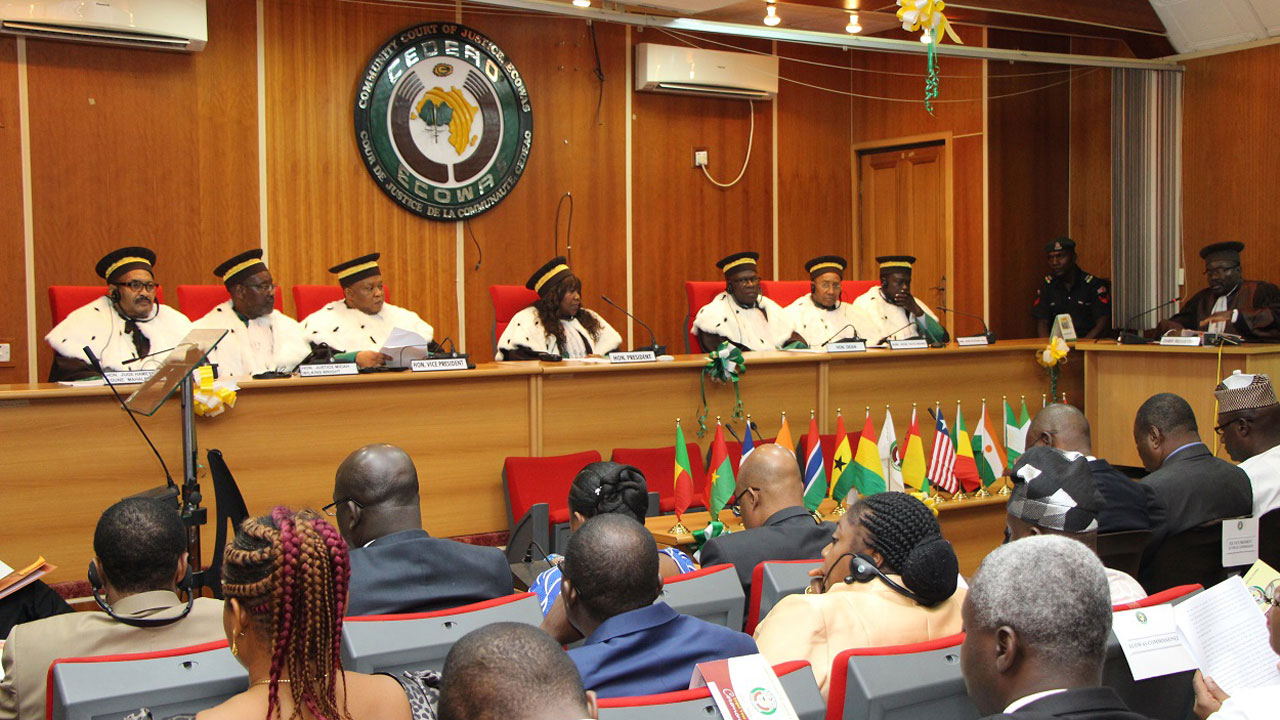


ECOWAS Court Marks 25 Years, Seeks Reforms For Stronger Justice Delivery
The President of the Community Court of Justice, ECOWAS, Justice Recardo Gonçalves, has called for reforms to strengthen the institution’s effectiveness and improve justice delivery as the Court marks its 25th anniversary.
A statement from the court on Monday said the Court president stated that the anniversary provided an opportunity to reflect on the Court’s progress over the past quarter century and “chart a bold vision for the future.”
He said the Court had evolved into an important regional judicial institution through successive reforms, particularly the expansion of its mandate and jurisdiction to include human rights protection.
According to him, the Court’s jurisprudence over the years had contributed to “As we commemorate the 25th Anniversary of the Community Court of Justice, ECOWAS, we are presented with a unique opportunity not only to celebrate the progress achieved over the past quarter century but also to critically assess our journey and chart a bold vision for the future. The protection of human rights, the promotion of legal certainty, the strengthening of democratic governance and the advancement of regional integration.”
Gonçalves, however, said the Court was at an important crossroads, requiring it to adapt to changing realities in governance, technology, human rights, regional mobility and economic transformation.
He said, “The changing realities of governance, technological advancement, evolving human rights challenges, increased regional mobility, economic transformation and the growing expectations of citizens all require us to continually adapt and innovate.”
The ECOWAS Court president said the institution had embarked on an institutional transformation process aimed at enhancing its effectiveness, accessibility and responsiveness.
He identified the approval of the Complementary Act on the ECOWAS Court of Justice in December 2025 as a significant milestone, saying it harmonised the 1991 and 2005 protocols governing the Court and strengthened its legal framework. He also noted the adoption of the Court’s Arbitration Rules in December 2025, saying the rules opened new opportunities for the peaceful and efficient settlement of disputes.
Gonçalves further disclosed that consultations were ongoing among Community stakeholders on the establishment of an Appeal Division of the Court. He said the proposed reform would “further strengthen judicial guarantees, improve the administration of justice and enhance confidence in the Court’s procedures and decisions.”
The Court president also identified the full and timely enforcement of court judgments as one of the critical challenges confronting regional justice. He said the conference would examine “the critical need to ensure a full and timely enforcement of Courts’ judgments” and identify practical ways of strengthening human rights protection, innovation, good governance and regional integration.
Gonçalves urged participants, comprising judges, policymakers, academics, legal practitioners, representatives of international organisations and civil society actors, to develop practical proposals for strengthening the Court.
He said, “We look forward to receiving clear, innovative and feasible proposals capable of strengthening the Court’s institutional framework, enhancing access to justice, improving judicial effectiveness and deepening the Court’s contribution to the regional integration agenda.”
He added that the future of regional justice would depend not only on institutions but also on the quality of collective reflection, partnerships and willingness to translate ideas into practical reforms.
The president said, “Together, let us use this occasion not merely to celebrate the past, but to shape the future; not merely to assess challenges, but to identify solutions; and not merely to discuss regional integration, but to strengthen the judicial foundations upon which that integration must continue to rest.”
The Commission’s President, Gen. Birame Diop, in a message delivered by the Director of Legal Affairs, Gaye Sowe, said the gap between the authority of the Court’s decisions and their execution remained a major test of the credibility of the regional legal order.
He said the Commission would continue to engage member states to designate competent national authorities for enforcement and keep compliance on the agenda of statutory meetings. “The Commission will continue to engage Member States, at the highest level, to designate the competent national authorities for enforcement envisaged under the legal texts on the Court,” he said.
He added that the Commission would also consider practical monitoring mechanisms that may emerge from the conference.