



Anti-corruption Fight Must Combine Punishment, Prevention- Russian Envoy
The Minister Counsellor of the Russian Embassy in Nigeria, Igor Ivannikov, has said the fight against corruption must combine punishment for offences already committed with preventive measures to address the underlying causes of the crime.
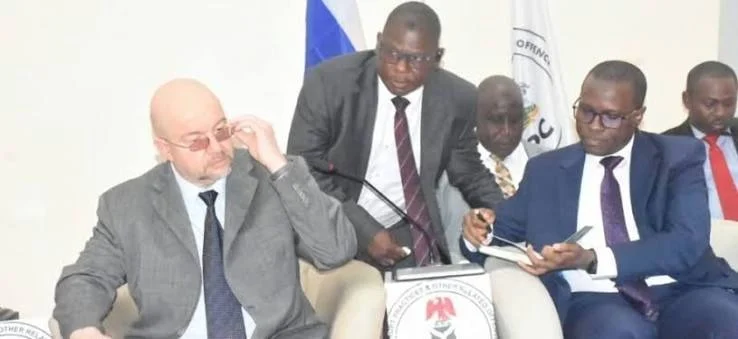
He stated this while outlining Russia’s anti-corruption framework and areas of possible cooperation with Nigeria at the diplomatic dialogue organised by the Independent Corrupt Practices and Other Related Offences Commission and the Anti-Corruption Academy of Nigeria in Abuja on Tuesday.
Ivannikov said, “Modern policy generally combines two areas: suppressing offences that have already been committed and addressing their underlying causes.”
He explained that Russia had developed a comprehensive anti-corruption system over several decades, combining law enforcement with measures designed to prevent corrupt practices.
According to him, criminal punishment alone does not eliminate the causes of corruption, adding that Russian legislation also focuses on preventing such conduct.
“The Russian model is based on the understanding that criminal punishment alone does not eliminate the causes of corruption. Therefore, the legislation also focuses on preventing such conduct, ” he said.
He identified income and property declarations by public officials as one of the preventive measures adopted in Russia.
He added, “Declarations make it possible to compare an official’s declared income with their property holdings. In some cases, expenditure monitoring is also applied.”
Ivannikov also identified the prevention of conflicts of interest as another instrument, saying the law required civil servants to report situations where their personal interests could affect the objective performance of their duties.
He said another mechanism was the anti-corruption review of existing regulatory laws to identify provisions that could create conditions for criminal conduct.
The diplomat also highlighted public procurement as an important area in the prevention of corruption, saying Russia had transferred significant parts of the process to an electronic platform.
According to him, the system “makes it possible to monitor different stages, from the publication of information about a tender to the conclusion and performance of a contract.”
He added that digitalisation “reduces opportunities for concealing information, makes it easier to review the actions of contracting authorities, and creates a common body of data for government oversight and public scrutiny.”
However, Ivannikov cautioned that technology alone could not eliminate corruption.
He said, “Digitalisation alone cannot eliminate the problem: its effectiveness depends on the quality of oversight, the accessibility of information, and the accountability of officials for violations.”
On prosecution, he said Russia had a clear division of responsibilities among law enforcement agencies, with the Ministry of Internal Affairs and Federal Security Service responsible for detecting corruption-related crimes within their respective areas of competence.
He said preliminary investigations were conducted primarily by the Investigative Committee, while the Prosecutor’s Office supervised compliance with the law during investigations.
Ivannikov further disclosed that Russia was ready to share its experience with Nigeria in financial investigations, tracing illicit funds and recovering assets located abroad.
He said Russia had developed a practical approach to international asset recovery through the Prosecutor General’s Office,” covering the search, seizure, confiscation and recovery of criminal proceeds located abroad.
“Russia has developed a practical approach to international asset recovery through the Prosecutor General’s Office. Its international cooperation includes the search, seizure, confiscation and recovery of criminal proceeds located abroad. The Prosecutor General’s Office has also prepared a practical step-by-step guide explaining how foreign authorities can request Russian assistance in identifying and recovering assets, “he said.
The envoy said there was already a legal basis for such cooperation, noting that Russia and Nigeria signed a Treaty on Mutual Legal Assistance in Criminal Matters in 2018, which was subsequently ratified by Russia.
Speaking, the ICPC chairman, Musa Aliyu, SAN, has said Nigeria would benefit from learning from Russia’s experience in tackling corruption.
He said Nigeria and Russia had maintained longstanding bilateral relations, with both countries signing agreements covering areas including air communication, economic, scientific and technical cooperation and trade.
According to him, the establishment of the ICPC under the Corrupt Practices and Other Related Offences Act 2000, alongside other anti-corruption institutions, demonstrated the Nigerian government’s commitment to tackling corruption.
He said, “As Nigeria continues to deepen its anti-corruption efforts, there is much value in learning from comparative experiences, understanding best practices, and identifying innovative approaches that can be adapted to our local realities.”