



INEC Engages JONAPWD, OPDs On Sensitisation, Mobilisation Of Persons With Disabilities Ahead Of 2027 Polls
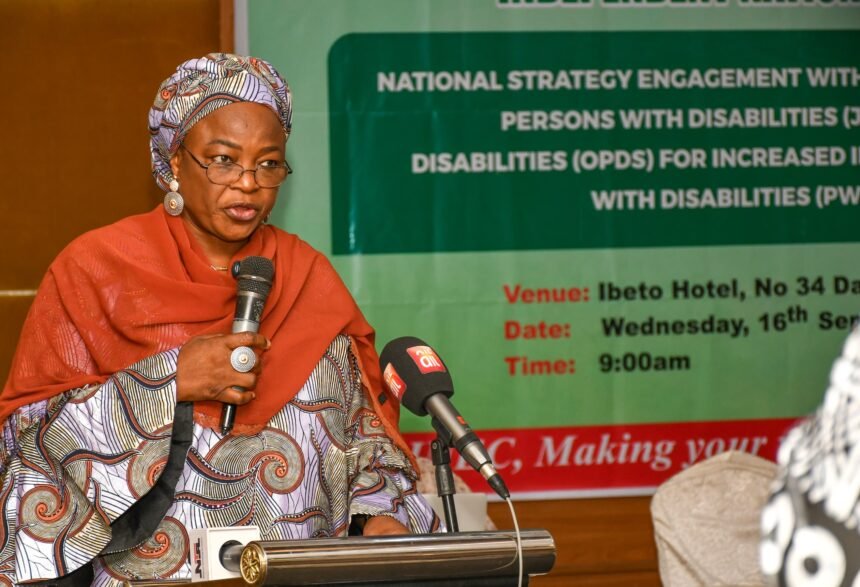
The Independent National Electoral Commission (INEC) has reaffirmed its commitment to an inclusive electoral process, as it held a National Strategy Engagement with Executive Members of the Joint National Association of Persons with Disabilities (JONAPWD) and Organisations of Persons with Disabilities (OPDs) in Abuja.
The engagement, held on Wednesday, 16th September, 2026, and themed on improved targeted sensitisation and mobilisation of Persons with Disabilities (PWDs) for increased turnout and participation in the 2027 General Election, drew leaders of JONAPWD, representatives of OPDs, Cluster Heads, development partners and officials of the Commission.
Declaring the engagement open, the INEC Chairman, Prof. Joash Amupitan, SAN, represented by the Acting Chairman and National Commissioner, Prof. Rhoda Gumus, welcomed participants and expressed the Commission’s appreciation for their “continued commitment to advancing the participation and inclusion of Persons with Disabilities in Nigeria’s democratic process.”
He said the meeting reflected the Commission’s commitment to an electoral process that is “inclusive, accessible, participatory and responsive to the needs of all eligible citizens, including Persons with Disabilities,” stressing that as INEC prepared for the 2027 General Election, it was important to “strengthen our collaboration with JONAPWD, OPDs and other relevant stakeholders to ensure that no eligible voter is left behind.”
The INEC Chairman said the participation of PWDs in the electoral process is anchored on Section 54 of the Electoral Act, 2026 (as amended), the Discrimination Against Persons with Disabilities (Prohibition) Act, 2018, and the INEC Framework on Access and Participation of Persons with Disabilities in the Electoral Process.
Citing data from the Commission’s ICT department obtained before the Automated Fingerprint Identification System (AFIS) exercise, he disclosed that a total of 137,487 Persons with Disabilities have so far been captured, comprising 13,080 visually impaired persons, 9,299 hearing impaired persons, 30,561 persons with albinism, 19,430 persons with physical impairment, and 54,941 persons in other categories of disability. He said the figures “further demonstrate the need for sustained and targeted engagement to ensure that Persons with Disabilities are adequately informed, mobilised and supported to participate throughout the electoral process.”
He noted that the outcome of the national engagement would not remain at the national level alone but would be replicated at the state level through Resident Electoral Commissioners, Electoral Officers and other relevant officials, “to ensure that the issues and strategies discussed here are translated into practical interventions at the grassroots.” He called on JONAPWD and the various OPDs to take ownership of the sensitisation process within their respective clusters.
The INEC Chairman further described the partnership between INEC, JONAPWD and OPDs as one that “cannot be achieved by the Commission alone,” noting that it “requires the collective efforts of disability organisations, civil society organisations and, most importantly, Persons with Disabilities themselves.” He urged participants to engage actively and contribute practical recommendations, adding that “the success of our collective efforts will depend on our ability to translate these discussions into concrete actions that can be implemented both at the national and state levels.”
In her welcome remarks, the Director, Gender and Inclusivity Department, Mrs. Lakunuya Dorothy Bello, said the Commission recognises PWDs as “an important constituency whose voices, choices and participation are essential to the credibility and inclusiveness of our democracy.” She listed persisting challenges to include access to voter information, voter education, mobilisation and accessibility of electoral facilities, and urged stakeholders to develop sensitisation strategies that are “broad in reach but also targeted, accessible and responsive.”
The objectives of the engagement were read by the Deputy Director in charge of Inclusivity, Mrs. Habiba Abdulkareem Jatto, who listed them to include strengthening collaboration between INEC, JONAPWD, OPDs and Cluster Heads; developing practical strategies for sensitising and mobilising PWDs; increasing collection of Permanent Voter Cards and voter turnout among PWDs; and enhancing the dissemination of voter education messages in accessible formats.
Delivering the keynote address, the Executive Director of Inclusive Friends Association (IFA), Grace Jerry, called for a mobilisation model built around mapping PWD networks and priority gaps, reaching communities through OPD and accessible media channels, delivering practical voter education in multiple accessible formats, supporting registration and referrals, monitoring and documenting barriers for escalation to INEC and JONAPWD, and sustaining follow-up engagement through Election Day. She urged JONAPWD, OPDs, INEC, political parties and partners to jointly identify and remove barriers to participation before the 2027 General Election, stressing that sensitisation efforts must reach OPD networks, wards, Local Government Areas, markets, campuses, faith and community spaces, and digital platforms.
In his goodwill message, the National President of JONAPWD, Comrade Abdullahi Aliyu Usman, commended INEC for owning a policy on disability inclusion that was itself shaped by Persons with Disabilities. He, however, called for more frequent strategic engagements, noting that “one national strategic engagement will not be enough for persons with disabilities in Nigeria to participate fully in the 2027 General Election.”
The Executive Secretary of the National Commission for Persons with Disabilities (NCPWD), Bar. Ayuba Gufwan Burki, decried the barriers of mobility, assistive devices and restricted movement during elections that continue to limit the participation of PWDs. He said, “if we are fully engaged, if we can mobilise 35 million people to an election, then we will determine where the votes will swing.”
Also speaking, the Founder/CEO of TAF Africa, Jake Epelle, commended INEC’s performance on priority voting for PWDs but called for improved accessibility of polling units and deeper grassroots mobilisation through OPD cluster heads across the 36 states and the FCT. He declared, “any election that fails to count the voices of persons with disability is not a democracy, it is an exercise in exclusion.”
The highpoint of the engagement was the reading of a communique arising from the engagement and its adoption by the National Secretary of JONAPWD, Mr. Ishaku Adamu, formalising the commitments and action points reached by stakeholders ahead of the 2027 General Election.