


Bringing Back Fuel Subsidy An Empty Campaign Buzz, Not Fiscally Realistic- Sanwo-Olu
•Lagos Governor delivers 7th Freedom Online Lecture; discusses gains, prospects of Tinubu’s reforms
•Sanwo-Olu: Nigeria’s democratic, electoral systems have evolved since 1999
Lagos State Governor, Babajide Sanwo-Olu has said that those campaigning for the return of oil subsidy are only resorting to populist politics that will ultimately fail.
subsidy’s return was simply building their campaign on empty promises that would end up deceiving voters.
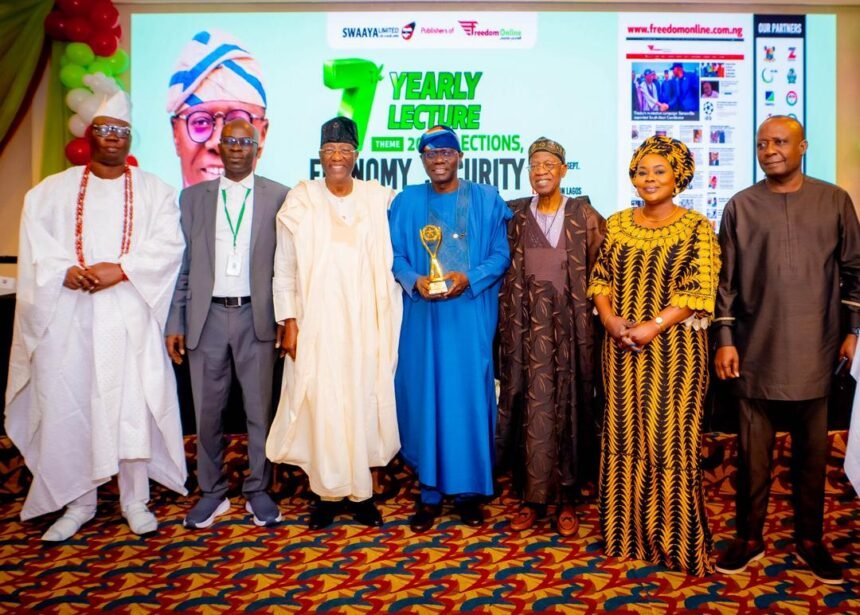
Sanwo-Olu’s comments were made on Thursday when he delivered the 7th Freedom Online Newspaper Lecture with the theme: “2027 Elections, Economy, Security and Nigeria’s Future”.
The lecture, chaired by former Minister for Information and Culture, Alhaji Lai Mohammed, was held at Sheraton Lagos Hotels, in Ikeja.
Former Ogun State Governor and Senator representing Ogun East, Sen. Gbenga Daniel, was the Special Guest of Honour.
Delivering a paper on the theme, Sanwo-Olu delved into the ongoing economic reforms, security matters and electoral reconfiguration being undertaken by the Federal Government, highlighting the gains and the prospects for future growth.
The Lagos helmsman observed that the oil subsidy policy, which was introduced to tackle the shortcomings of local oil supplies stemming from inefficiencies at state-owned refineries, was not intended as a permanent intervention.
Sanwo-Olu said that the subsidy policy had become a burden on the nation’s finances, draining the nation’s treasury and squandering funds that could have been invested in building roads, schools, hospitals and other infrastructure relevant for the wellbeing of the nation.
By taking the courage to end the corruption-ridden subsidy programme, the Governor said President Bola Ahmed Tinubu made the sacrifice that previous leaders had avoided, damning the impact the action could have on his electoral fortunes.
Sanwo-Olu said: “The oil subsidy was not removed because anybody enjoyed removing it. It was removed because it had become a hole in the national purse through which the money for roads, schools and hospitals was draining away. The intervention was never reaching the ordinary motorist it was supposed to help. In the build up to the 2023 elections, every major candidate promised to remove it. Only one of them was in a position to do it, and he did it on his first day in office.
“I will not stand here and tell you that oil subsidy removal has been painless. It has not. Lagosians particularly have felt it at the pump, at the market, and in the price of a bag of rice. Any governor who tells you otherwise has not been listening to his own people. But, the measure of a reform is not whether it hurts. It is whether it heals. And the evidence that this one is healing is now arriving, quarter by quarter.
“Under President Tinubu, the States have had it very good. Since the subsidy was removed, the monthly allocations to States and local governments have more than doubled in Naira terms. The President has done his part; the money is arriving. Barely two weeks into the season of presidential election campaign, opposition politicians have reached for the fuel subsidy as their instrument of choice. We will see more of this. We will see promises that no treasury on earth could honour.”
Sanwo-Olu said he strongly believed in the direction of the reforms initiated by the President to reset the economy and the socio-political system, pointing out that the reforms were already yielding positive outcomes across the areas where they were being implemented.
In 2026 alone, the Governor said the nation’s economy grew by 4.43 per cent from 3.89 per cent in the first quarter, against the 4.23 per cent recorded in first quarter of 2025.
Agriculture sector, Sanwo-Olu said, grew by 4.39 per cent, up from 2.82 per cent a year earlier, adding that the growth in the service sector was up 4.6 per cent in the current year.
The Governor said: “In nominal terms, the national economy is more than 18 per cent larger than it was twelve months ago. Our external reserves stood at $53 billion last week, the highest they have been since January 2009. We are running a trade surplus. Both Fitch and Moody upgraded Nigeria’s credit rating last year. Inflation, which peaked at almost 35 per cent at the end of 2024, was 15.9 per cent last June. The Naira has held its ground against the dollar for the better part of a year.
“This week, too, the Central Bank reported that Nigerians abroad sent home $947 million through formal channels in the month of July. That is the largest monthly figure in our history, and it is within touching distance of the $1 billion-a-month target that many people laughed at when it was set two years ago. These statistics are not my numbers; they belong to the National Bureau of Statistics and the Central Bank of Nigeria, and every journalist seeking facts can check them.”
Sanwo-Olu gave a positive verdict on the nation’s democracy, noting that Nigeria’s political and electoral systems had continued to evolve in a sub-continent where democracy had been under siege, alluding to the seizure of power by soldiers in Mali, Guinea, Burkina Faso, Niger and Guinea-Bissau.
Evidence of democratic stability, he said, could be seen in the reforms introduced in the electoral process, which, the Governor noted, had been correcting past mistakes that led to the collapse of previous republics.
“Our elections have improved. Anyone who covered the elections of the 2000s knows how far we have come. Much of that distance was travelled under the All Progressives Congress’ watch. The ruling party initiated the Electoral Act of 2022 and now the Electoral Act of 2026, and the technology that verifies voters and transmits results. This is not the moment to rest on our oars. INEC must be ready in every polling unit on January 16, 2027, and again on February 6, 2027.
Each of us has a duty to help the electoral umpire be ready,” Sanwo-Olu said.
Is the nation safe under the current government? Sanwo-Olu considered the question a matter of individual perception but emphasised that President Tinubu had given the nation’s security architecture the priority it deserves like any Commander-in-Chief since 1999.
The Governor said poverty remained the primary cause of insecurity, reason President Tinubu’s interventions directly addressed the most pressing needs of the youth — the vulnerable demographic — in addition to strengthening the capacity of the security forces.
“Consider what has been done in the last three years. In July, President Tinubu approved the expansion of the Nigerian Army from eight divisions to twelve, with 28,000 additional personnel and new divisional headquarters in Makurdi, Ilorin, Jalingo and Benin City, closer to the theatres where they are needed. The Navy has a new Special Operations Command. Police training has been decentralised. Forest Guards and Mining Marshals now operate in spaces that were, for years, simply ungoverned. In May, a joint operation with our American partners led to the elimination of some of the most wanted terrorist commanders in the Lake Chad Basin.
“The President believes the most effective security policy is job creation, and the surest guarantee of a job is a country safe enough to invest in. The President’s interventions have gone straight at the poverty that feeds insecurity, and straight at the demographic with the most to gain or to lose, which is our young people. NELFUND is keeping students in school who would otherwise have dropped out. The Consumer Credit Corporation is building the credit culture without which no modern economy functions.”
“The 3-Million Technical Talent program is training the workforce of a digital economy. The recently unveiled reform of the National Youth Service Corps is turning a year of service into a year of enterprise. Behind all of these stand the Nigerian Youth Academy, the Nigeria Health Fellowship, the Student Venture Capital Grant, the Power Force programme and the Labor Employment and Empowerment Programme. It is hard to name an administration that has invested in young Nigerians on this scale,” Sanwo-Olu submitted.
Mohammed described the media lecture as an “intellectual platform” and “a staple for national reflection”, noting that the choice of Sanwo-Olu as the lecturer was fitting, given the Governor’s understanding of complex demands of governance, security, infrastructure development and economic innovation.
The former Minister said political stability depended on economic inclusion. He noted that security was a precondition for economic growth, stressing that no business would thrive in an atmosphere of uncertainty.
He said: “When young people are gainfully employed and see a clear path to self-actualisation, the political space becomes far less susceptible to manipulation and electoral violence. The 2027 election must be viewed not merely as a contest for power, but as a commitment to continuity and nation-building.
“Politics must never be allowed to override governance. The real measure of our democratic progress is whether our electoral outcomes strengthen institutions, bolster investor confidence and guarantee peace across our communities.”
While acknowledging the Federal Government’s effort is confronting “difficult challenges” in the areas of security and economic reform, Mohammed said the challenges would not be solved overnight.
“They require consistency, patience, institutional strengthening and, above all, national cooperation,” the former Information Minister said.
Convener and Freedom Online Editor-in-Chief, Mr. Gabriel Akinadewo, said the lecture came against the backdrop of renewed political activities and the need for politicians to place the nation’s development above the game of politics.
The veteran media practitioner advocated for modernisation of the nation’s laws to align with 21st-century realities and modern aspirations of the country. He emphasised the need to abolish outdated laws to create a new foundation for system that will protect citizens’ freedom.