




Nepal Flood Horror: 579 Dead, 1,924 Missing
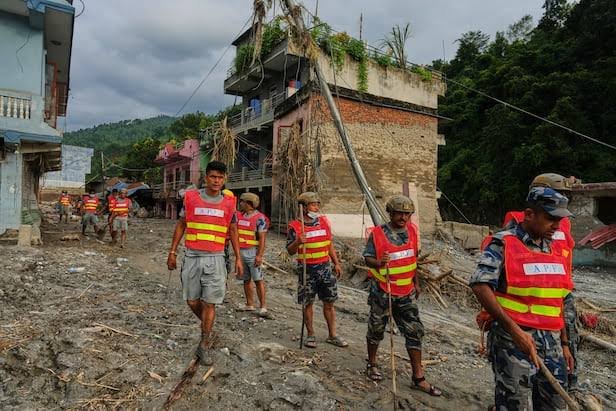
The death toll from devastating flash floods triggered by a glacier collapse in Nepal has risen to 579, with 1,924 people still missing, as rescuers race to find survivors amid fears of further flooding in the Himalayan region.
The disaster, which struck northern Nepal and adjoining Tibet on Wednesday, has affected more than 90,000 people, destroyed roads, bridges and other critical infrastructure, and left hundreds of foreign tourists and pilgrims unaccounted for.
Reuters reported that rescue operations resumed on Friday after being briefly suspended over fears that a lake formed by flood debris could burst its banks and unleash another torrent of water and mud.
Nepalese authorities said the threat had eased sufficiently for search and rescue teams to return to the affected areas, although two upstream barrier lakes were still being monitored for possible flooding.
The flash flood was triggered after a glacier collapse sent huge volumes of rock, ice, mud and debris into Himalayan river systems, sweeping through villages and destroying homes, roads, bridges and power installations.
The affected route, which links Kathmandu with Lhasa in Tibet, is popular with trekkers and pilgrims, including people travelling to Mount Kailash and Lake Mansarovar.
At least 540 foreigners are among those reported missing in Nepal, according to authorities, with nationals from countries including India, China, the United States, Malaysia, Ukraine, Britain, Australia and Canada affected.
China’s Tibet region has also recorded five deaths, while 558 people remain missing in Gyirong County, including 260 foreign nationals, according to Chinese authorities.
In northern India, 10 bodies believed to have been swept downstream from Nepal were recovered from rivers in Uttar Pradesh, police said.
The scale of the disaster has overwhelmed some local facilities, with emergency workers struggling to accommodate recovered bodies and identify victims.
In Bharatpur, one government building has reportedly been converted into a temporary mortuary after existing morgues and hospitals became unable to cope with the number of bodies being recovered.
Some remains were badly damaged after being swept through the floodwaters, making identification particularly difficult. Police have been photographing identifiable bodies and displaying information to families searching for missing relatives.
Meanwhile, helicopters have been deployed to search remote valleys and deliver emergency supplies to communities cut off by destroyed roads and damaged communication networks.
More than 3,700 people have so far been rescued, including survivors who were trapped inside a tunnel at a hydroelectric project under construction.
The International Federation of Red Cross and Red Crescent Societies said about 93,000 people had been affected and were in urgent need of humanitarian assistance.
Its head of delegation in Nepal, David Fisher, warned that the humanitarian situation could deteriorate if additional flooding occurs.
“We’re of course very concerned about the secondary flood,” Fisher said, adding that relief trucks had been blocked by a lake formed by the landslide.
The United Nations Office for Disaster Risk Reduction also warned that the disaster was still evolving, with the possibility of further hazards.
Nepal is using satellite imagery to monitor two barrier lakes upstream from the flood zone. One of the lakes has reportedly increased in size, raising concern that continued accumulation of water could create another dangerous flood.
Chinese authorities have similarly warned of continuing risks from unstable glacial lakes in the region, even though the immediate threat from one flood-created lake has eased.
The World Health Organisation said six health facilities had been damaged while eight healthcare workers were missing.
The agency warned that displacement, overcrowding and disruptions to water, sanitation and health services could increase the risk of infectious diseases, including diarrhoea and respiratory illnesses.
The disaster has also triggered an international response, with several countries offering search-and-rescue assistance.
India, China, the United States, Britain, Japan, South Korea, Sri Lanka and Bangladesh have reportedly offered assistance, although Nepal said it did not currently require foreign rescue teams.
In China, President Xi Jinping’s government has called for stronger monitoring of glacier lakes and landslide risks, emergency assistance for affected communities and increased international cooperation on disaster response.
The flooding has renewed concerns over the growing vulnerability of Himalayan communities to climate-related disasters.
Nepal’s Himalayan glaciers have lost a significant proportion of their ice in recent decades, with scientists warning that rising temperatures can increase meltwater and weaken ice and rock structures, potentially heightening the risk of cascading hazards.
As rescue teams continue searching for survivors, families have gathered at military bases and other emergency centres, studying lists of rescued people and photographs of unidentified bodies in the hope of finding their relatives.
The authorities have maintained that the search will continue despite the difficult terrain, damaged infrastructure and continuing risk of fresh flooding.