


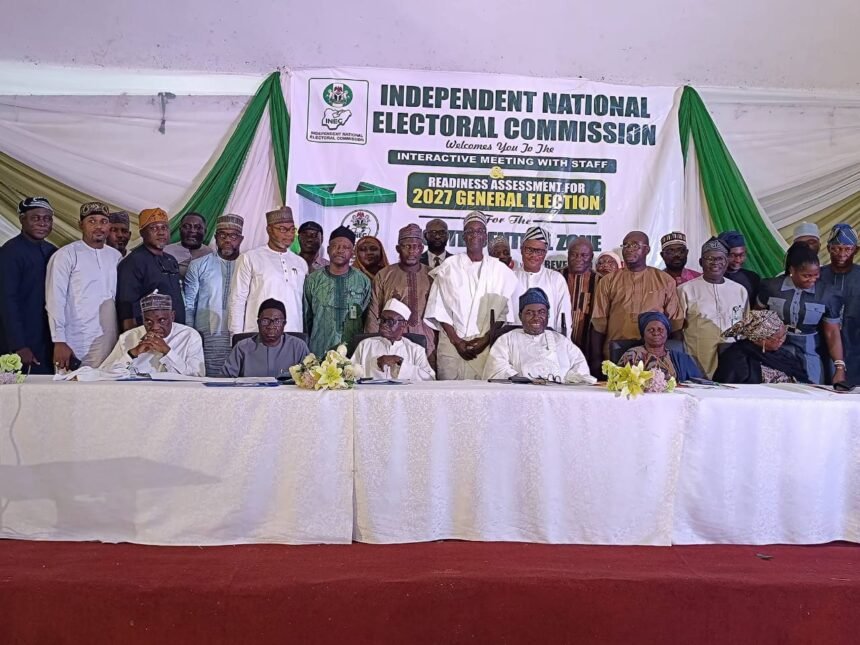


2027: INEC Concludes Nationwide Readiness Tour In Lokoja
The Independent National Electoral Commission (INEC) has concluded its nationwide operational readiness tour ahead of the 2027 General Election, with the Chairman, Professor Joash Amupitan, SAN, declaring that nine of the 14 major statutory milestones in the election timetable have been executed.
Prof. Amupitan made the declaration on Friday 6th November, 2026, in Lokoja, Kogi State, at the North-Central Zonal Interactive Meeting with Staff and Readiness Assessment for the 2027 General Election, which brought the tour to a close.
The meeting brought together National Commissioners, Resident Electoral Commissioners (RECs) from the zone, Directors from the National Headquarters, Administrative Secretaries, Heads of Department and Electoral Officers.
He said the North-Central engagement was the strategic culmination of similar assessments already held in the South-West, North-West, South-East, North-East and South-South.
According to him, the tour was intended to identify operational weaknesses before election day, ensure that local challenges were reflected in national planning and prevent voters from being disenfranchised through administrative or logistical failures.
The Chairman said the remaining preparations required increased attention as the election dates approached. He directed that no staff of the Commission should proceed on annual leave until after the elections.
He said the 2027 General Election would involve over 103 million registered voters across 176,846 polling units. The Presidential and National Assembly elections are scheduled for January 16, 2027, while the Governorship and State Houses of Assembly elections will hold on February 6, 2027.
Prof. Amupitan said the Commission’s conduct of governorship elections in Anambra, Ekiti and Osun, the FCT Area Council elections and 16 bye-elections had served as test grounds for the general election.
He warned that partisanship, negligence, financial impropriety and absenteeism would attract swift sanctions, in line with Section 26 of the Electoral Act 2026, which mandates a formal Oath of Neutrality. He charged staff to remain neutral and disciplined, saying:
“You are the human bridge translating the Electoral Act 2026 into democratic reality. Know the law, understand your responsibility, maintain absolute neutrality, document every action, and protect the integrity of the ballot.”
On staff welfare, the Chairman said the Commission was at an advanced stage of implementing the newly approved Consolidated Election Management Body Salary Structure (CEMBSS).
He added that the Commission had approved enhanced salary, hazard and field allowances, alongside a 150 per cent increase in monthly overheads to state offices, effective July 1, 2026.
On logistics, he said operational pick-up vehicles had been distributed to state and Local Government Area offices. Twenty Sports Utility Vehicles had been procured for RECs, while Administrative Secretaries would also receive new vehicles.
On technology, Prof. Amupitan said the Commission was configuring Bimodal Voter Accreditation System (BVAS) devices, including 57,000 newly procured units. He said electronic result management systems were being audited to ensure transparent transmission of polling unit results to the INEC Result Viewing Portal (IReV).
He said Printable Permanent Voter Cards (PVCs) and a digital PVC Location Portal had been activated, and that the preliminary register of voters had been published for public display. The certified Register of Voters will be published on December 15, 2026.
Addressing concerns over photographs appearing on the preliminary register, he said the data remained subject to verification before the final register was published.
On election security, the Chairman unveiled an intelligence-led framework under the Inter-Agency Consultative Committee on Election Security (ICCES), which he called the “ICCES Tentacle”. It extends security coordination from the national headquarters to Local Government Areas and Registration Area Centres.
He warned those planning to disrupt the process:
“Insecurity may pose a challenge, but our constitutional resolve is stronger. Anyone attempting to threaten, intimidate, or harm our ad-hoc staff, NYSC members, or permanent personnel will face the full weight of the law.”
Warning against fake news and digital disinformation, he said staff conduct remained the Commission’s strongest defence. He said:
“When our field execution is flawless, and our data pipeline is clear, no digital algorithm can displace the physical reality of a transparent vote.”
Prof. Amupitan described Kogi State as Nigeria’s ultimate electoral gateway, sharing boundaries with 10 states and the Federal Capital Territory (FCT). He said the North-Central zone has 15,448,869 registered voters, with Kogi accounting for 1,932,654.
By state, Benue has 2,777,727 voters, Plateau 2,787,273, Niger 2,698,344, Nasarawa 1,899,244, Kwara 1,698,627 and the FCT 1,655,000.
In his welcome address, the REC for Kogi State, Dr. Shehu Wahab, described Lokoja as the historic confluence city where Rivers Niger and Benue meet. He urged staff to draw inspiration from its history of good leadership to deliver a credible election.
He said the Chairman’s visit was a morale booster and that the state office was preparing for the polls despite added responsibilities arising from the restoration of 12 previously suppressed State Constituencies. He added that the office was working with security agencies to change the perception of Kogi as a violence-prone state during elections.
The Director of Planning and Monitoring, Mrs. Helen Ajayi, said the assessment was designed to motivate staff, evaluate state preparedness and identify operational and logistical challenges. She highlighted Electoral Risk Management (ERM) as a key tool for mapping risk areas, and stressed the importance of traditional rulers in grassroots mobilisation for the 2027 General Election.
Directors from the National Headquarters also presented updates on voter registration, ICT, staff conduct, and operational and logistics readiness, while State representatives presented situation reports on election security, training, voter education and stakeholder engagement.
Staff representatives appreciated the Chairman’s visit and stressed the importance of welfare in sustaining motivation, professionalism and resistance to undue external influence.
The Friday meeting followed engagements on Thursday, November 5, 2026, during which the Chairman paid a courtesy visit to the Kogi State Council of Traditional Rulers, describing it as a homecoming.
He said the Commission could not independently guarantee peaceful elections without the cooperation of community leaders. He appealed to the royal fathers to support the Commission in three areas: mobilisation for PVC collection, discouragement of electoral violence and political thuggery, and the fight against misinformation, including deepfakes generated by artificial intelligence.
He disclosed that PVC collection was being decentralised across the 774 Local Government Areas, including all 21 in Kogi State, with collection points moved closer to citizens at ward level.
The Chairman assured the people of Kogi State and the North-Central zone that INEC remained politically neutral, declaring that the Commission had no candidate.
The delegation was received by the President and Chairman of the Council, His Royal Majesty, Dr. Matthew Alaji Opaluwa Oguche Akpa, the Attah Igala. Also present were the Ohinoyi of Ebiraland, His Royal Majesty Alhaji Ahmed Tijani Muhammad, and the Obaro of Kabba and Chairman of the Okun Area Traditional Council, His Royal Majesty Oba Solomon Dele Owoniyi.
Responding on behalf of the Attah Igala, the Ohinoyi of Ebiraland, who is Vice President of the Council, pledged the Council’s collaboration with INEC and described Prof. Amupitan’s appointment as a source of pride to the people of Kogi State. He urged the Chairman to remain committed to fairness, transparency, accountability and the rule of law.
On the same day, the Chairman commissioned a newly constructed BVAS storage facility in Lokoja. He said it was designed to address challenges arising from improper storage and inadequate cooling of the devices, and that dedicated storage facilities across the states would preserve battery life, maintain optimal performance and extend the lifespan of the devices.
Prof. Amupitan commended the quality of construction of the facility and said the Commission would work with its ICT Department to address outstanding requirements, including the installation of equipment racks. He congratulated the Kogi State REC and the management of the state office on the initiative.