


2027: Hamzat Rhodes-Vivour, Doherty Unveil Plans For Lagos
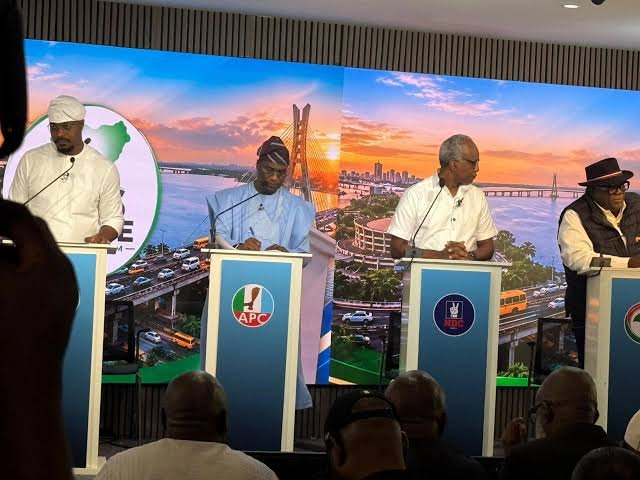
Governorship candidates of the African Democratic Congress (ADC), All Progressives Congress (APC), Nigeria Democratic Congress (NDC) and Peoples Democratic Party (PDP) have presented their proposals for addressing some of Lagos State’s major challenges, including housing, transportation, and healthcare, ahead of the 2027 governorship election.
The candidates made their positions known during the 2027 Lagos State governorship debate organised by Vanguard, Channels Television, TVC, Punch Newspapers, and The Cable on Sunday.
The ADC candidate, Gbadebo Rhodes-Vivour, promised to deliver more than 100,000 housing units if elected, saying his administration would prioritise affordable accommodation for ordinary residents rather than the wealthy.
He said the proposed houses would be allocated transparently to prevent individuals from acquiring multiple units under the scheme.
“The elites, the rich, can do it for themselves. The government’s role is to lift up people that cannot do it for themselves, and this comes into housing to ensure that we deliver 100,000-plus housing units and make it affordable so that it is transparently allocatable. We are not going to have a situation where one person can own ten units,” Rhodes-Vivour said.
The ADC candidate also promised legislation to protect tenants against arbitrary rent increases, proposing that landlords should give at least six months’ notice before increasing rents, with the increment guided by a stipulated percentage.
He added that a feedback mechanism would be established to enable tenants to report landlords who violated the proposed regulations, assuring that offenders would be brought to justice.
The All Progressives Congress candidate, Obafemi Hamzat, who is the incumbent deputy governor, pledged to enforce existing regulations against arbitrary rent increases and the demand for multiple years’ rent in advance.
Hamzat said his administration would ensure compliance with the Lagos State Real Estate Registration Agency Law, stressing that tenants should not be required to pay two or three years’ rent upfront.
“The next chapter for Lagos is to enforce. To make sure people are not asked two or three years ahead, because people don’t get paid two or three years ahead,” he said.
He also said the state had established 24 housing estates in the last eight years, promising to expand access to quality accommodation through increased mortgage facilities and the completion of ongoing housing projects across the state.
The NDC candidate, Funsho Doherty, called for greater government involvement in providing affordable housing, arguing that private developers alone could not meet the accommodation needs of low- and middle-income residents.
He also proposed the establishment of an ombudsman’s office to address what he described as exploitation of tenants through excessive agency, legal and other charges.
Doherty said the housing shortage was largely driven by the failure of supply to keep pace with population growth and demand, particularly in the affordable and social housing segments.
He argued that government should take the lead in addressing the gap rather than leaving housing provision largely to private investors. According to him, the last major government-led housing intervention in the state was during the administration of former Governor Lateef Jakande.
Meanwhile, the PDP candidate, Adedeji Doherty, proposed that the Lagos State Government should become a major property developer and build houses which residents could rent directly from the government.
He argued that government regulation alone could not force private landlords to reduce rents, insisting that the state should compete with them by providing more affordable accommodation.
“There is no landlord, and there is no government that can control a landlord. What we are going to do is very simple. “We are going to rent those houses ourselves, and then you can come and rent from us if you want to,” he said.
Doherty maintained that government must become the biggest housing developer in the state and provide alternatives to private rental accommodation.
“If they cannot compete with the landlords, then let us forget it,” he said.
Infrastructure
On flooding and infrastructure, the candidates offered different approaches to managing Lagos State’s environmental challenges, with proposals ranging from improved drainage systems and wetland protection to climate adaptation, better road construction standards and infrastructure maintenance.
The ADC candidate, Gbadebo Rhodes-Vivour, said Lagos needed visionary leadership and modern engineering solutions to address flooding, particularly given its low-lying coastal geography.
He cited cities such as Japan, Venice and the Netherlands as examples of places that had adopted innovative approaches to managing water, arguing that Lagos should learn from their experiences.
Rhodes-Vivour criticised the practice of indiscriminate sand-filling of wetlands, saying alternative construction methods could allow water to flow naturally without worsening flooding. He cited the Makoko community as an example, arguing that building structures on concrete stilts could provide an alternative to filling wetlands.
“There’s a technology there that they could have used, where we can build on concrete steels that still allow for water to flow,” he said.
The ADC candidate also called for stricter standards for road construction, arguing that some newly constructed roads developed potholes shortly after the rainy season began.
He also promised to protect wetlands from indiscriminate development, suggesting that such areas could be used for parks and solar farms.
The All Progressives Congress candidate, Obafemi Hamzat, however, defended the state’s drainage infrastructure, describing it as extensive and stressing that its effectiveness depended largely on regular maintenance and preventing blockages.
Hamzat, who is a former commissioner for works and infrastructure, said Lagos faced significant environmental challenges because of its low-lying geography, heavy rainfall and large population. According to him, the priority should be ensuring that water moves freely through drainage channels into the creeks and lagoon.
“Our going forward for us is to make sure that we maintain what we have built. Our climate change is real,” he said.
Hamzat also defended the environmental assessment of the Lagos-Calabar Coastal Road project, saying the assessment had been conducted when he was commissioner for works and infrastructure.
He explained that the removal of structures from certain locations was necessary where buildings obstructed floodplains and the natural movement of water.
The PDP candidate, Funsho Doherty, attributed Lagos’s flooding and environmental problems to what he described as years of governance failures, particularly the destruction of wetlands and development on drainage channels.
He said the state’s coastal and low-lying geography required stronger environmental management to prevent residents from being exposed to avoidable flooding risks.
Doherty described wetlands as natural systems that absorb excess water during rainfall, warning that destroying them and attempting to replace their functions with artificial drainage channels would not adequately address the problem.
He also criticised the practice of allowing buildings to spring up on drainage channels before demolishing them years later, arguing that proper planning and enforcement would prevent such situations.
The PDP candidate further faulted the Lagos State Government for what he described as its failure to insist on an environmental impact assessment before construction began on the Lagos-Calabar Coastal Road. Although the project is being undertaken by the Federal Government, he argued that the state government had a responsibility to protect its residents and ensure that environmental concerns were addressed.
Meanwhile, the NDC candidate, Adedeji Doherty, identified drainage as a major concern, calling for the redirection of drainage channels to improve water movement and reduce flooding.
He described flooding as a geographical phenomenon occurring in different parts of the world, arguing that the priority should be how effectively governments manage its effects.
Doherty also called for improved transportation arrangements for elderly and physically challenged residents, saying their transportation needs should be separated from the BRT vehicles operating on dedicated lanes.
Transportation
The ADC governorship candidate, Gbadebo Rhodes-Vivour, proposed decentralising development across Lagos State and expanding public transportation infrastructure to reduce traffic congestion, saying residents should not have to spend hours commuting to work.
He promised to deliver rail services across the state within two and a half years through partnerships with private investors and infrastructure finance companies, arguing that the project could generate enough revenue to repay its financing over 30 years without burdening the state’s balance sheet.
“Traffic is not a lifestyle, and we should not have to work to get to work,” Rhodes-Vivour said, adding that the state should also develop short bridges connecting different parts of Lagos, expand water transportation, introduce cable cars and establish dedicated bicycle lanes.
He further proposed ferry terminals with adequate parking facilities to enable residents to park their vehicles and continue their journeys by water, while advocating improved inner roads to make movement within local communities easier.
The APC candidate, Obafemi Hamzat, promised to expand the state’s Bus Rapid Transit (BRT) system from 1,000 to 4,000 buses, with a target of transporting one million passengers daily using compressed natural gas-powered vehicles.
Hamzat, who is the incumbent deputy governor, said the plan would also include additional BRT lanes linking Marina with areas such as Epe and Badagry, alongside the integration of road, rail and water transportation through a single payment system using the Cowry Card.
“There is nowhere in Africa, none, that private sector has funded a rail. No, in the whole of Africa,” he said, while defending government-led investment in rail transportation.
He also proposed introducing 77 electric ferries to reduce travel time on waterways, establishing a major ferry terminal at Oworonshoki and completing improvements at 63 traffic junctions, of which he said 42 had already been addressed.
The NDC candidate, Funsho Doherty, criticised the state of public transportation in Lagos, saying existing roads were poorly managed and residents continued to depend on ageing and dilapidated commercial buses.
He argued that the state needed to modernise its public transportation system, describing the continued operation of poorly maintained buses as a major contributor to traffic congestion and disorder on Lagos roads.
“In my opinion, the lack of a modern transportation system in Lagos is not by accident. I think there’s a vested interest in operating the bus system the way we’re operating it, with many small buses chaotically operated,” Doherty said.
He attributed the situation to a lack of political will, alleging that vested interests within the existing transport system had prevented necessary reforms. He promised to modernise public transportation, saying his administration would be accountable to voters rather than what he described as an entrenched transport network.
The PDP candidate, Adedeji Doherty, identified poor roads, traffic congestion around the Apapa port, ageing commercial buses and the activities of transport unions as some of the challenges confronting Lagos’s transportation system.
He said addressing the gridlock would require road rehabilitation across local government areas, improved management of trailer movements and the construction of additional bridges to provide alternative routes for commuters.
“The trailers coming in and going out of Lagos is one issue. NURTW is one issue. The bad roads is one issue. The rickety buses is one issue. The Fourth Mainland Bridge not being built up to date after 10-15 years is a big issue,” he said.
Doherty also proposed additional bridges linking different parts of the state, including routes connecting Kara to Lagos Island and Badagry, as well as Oworonshoki to Epe and Ibeju-Lekki. He said such infrastructure would help divert traffic and reduce congestion in busy parts of Lagos.
Healthcare
The ADC governorship candidate, Gbadebo Rhodes-Vivour, promised to establish 245 emergency response centres across Lagos State, with each ward having two ambulances to improve access to urgent medical care and reduce deaths caused by delays in reaching hospitals.
He said the centres would also provide wellness services and promote preventive healthcare through medical education, exercise facilities and community-based programmes, particularly for retirees and pensioners.
“Our focus will first be to establish emergency response in every ward in Lagos State. So that’s 245 emergency response centres in Lagos State with two ambulances, because there are too many people that are dying because they are moving from one place to the other, trying to find a hospital, a bed, oxygen,” he said.
Rhodes-Vivour also promised to increase healthcare funding to as close to 15 per cent of the state budget as possible, improve doctors’ salaries, train support staff and introduce artificial intelligence to strengthen medical diagnosis and healthcare delivery.
The APC candidate, Obafemi Hamzat, promised to expand enrolment in the state’s health insurance scheme, Ilera Eko, from its current 1.4 million beneficiaries to one in every three Lagos residents to reduce the financial burden of accessing medical care.
He also outlined plans to expand general hospitals, upgrade primary healthcare centres and increase the number of medical professionals, including through the establishment of a new university of medicine.
“Ilera Eko currently has 1.4 million people on it. We must push it to one in every three people in Lagos. That allows you to make sure that when illness comes, you don’t get ruined,” Hamzat said.
He said the state was developing new 150-bed facilities, including Massey Children’s Hospital and another general hospital, while promising to increase bed capacity at nine general hospitals by 50 per cent. He also pledged to upgrade about 150 primary healthcare centres to 24-hour flagship facilities and expand medical training to produce up to 1,000 doctors.
The NDC candidate, Funsho Doherty, called for increased government spending on healthcare and education, proposing that their combined allocation should rise from about 15 per cent of the state budget to 28 per cent during his first term.
He also promised fully free maternal and child healthcare, including consultations, medical tests and drugs, arguing that the cost of obtaining medicines and carrying out tests outside public hospitals prevented many low-income residents from accessing treatment.
“We’ve also said that maternal and child care for us, free, not nominally, but fully free, inclusive of drugs,” Doherty said.
He argued that health insurance schemes alone would not adequately address the needs of poor residents without direct government funding for medical care, saying the administration should begin with free maternal and child healthcare before gradually expanding the programme.
The PDP candidate, Adedeji Doherty, promised to strengthen the healthcare system by addressing shortages of doctors, nurses, hospital beds, medicines and other essential medical supplies.
He said Lagos needed more medical personnel and better-equipped hospitals to meet the healthcare demands of its growing population, while also identifying primary healthcare centres and pharmacies as important parts of the system.
“We have to work on the doctors. Those doctors, we need to train more doctors and more nurses because we are a growing state,” he said.
Doherty also proposed supporting local industries involved in producing medical equipment, hospital beds and pharmaceutical products, saying the government would reduce charges imposed on such businesses to encourage local production and improve the availability of essential medicines.